
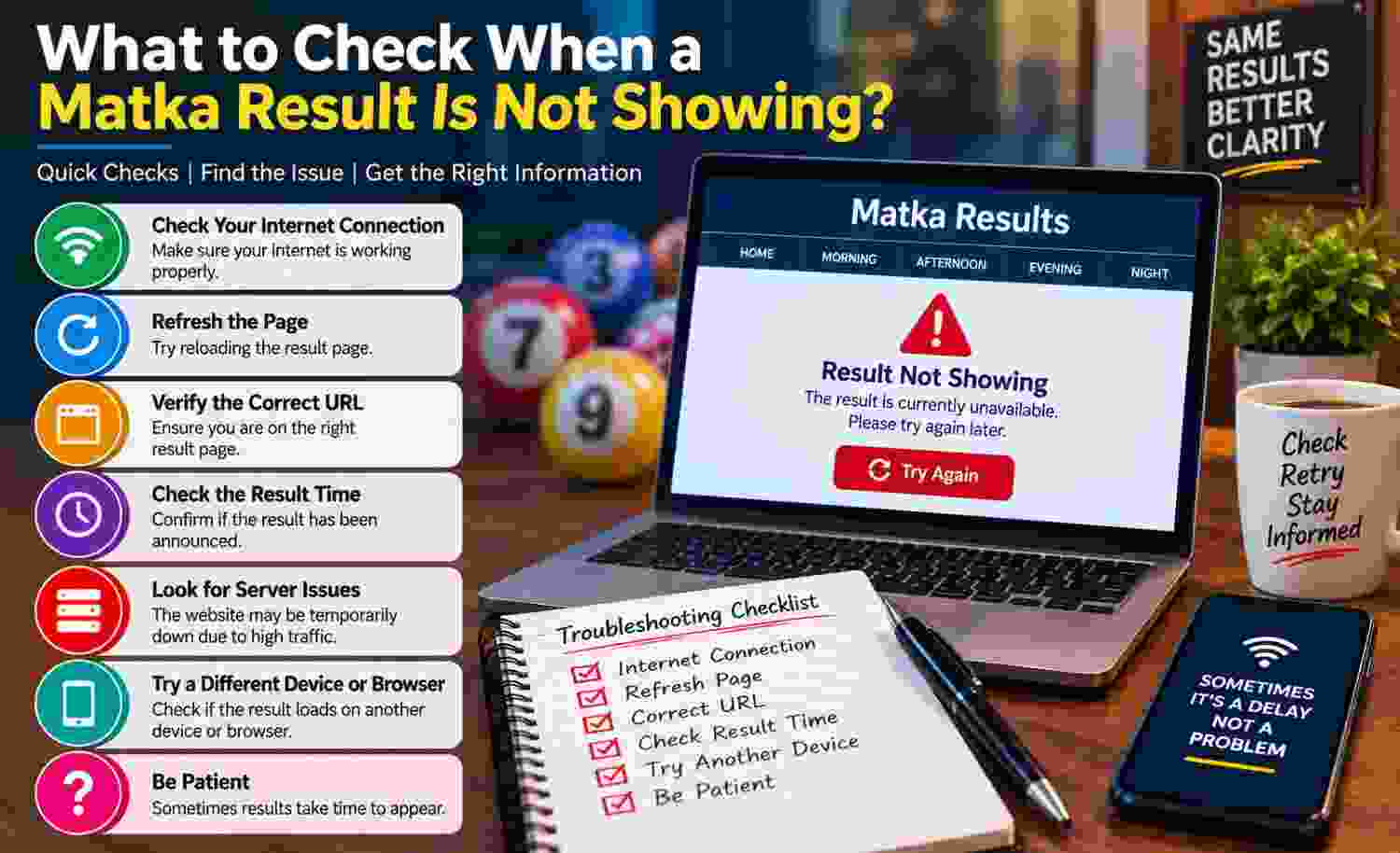
A Matka result may fail to appear for several ordinary reasons, including an incorrect date, the wrong market, an incomplete session, delayed publication, archive movement, or a stale browser view. Before treating the information as unavailable, check how the result page is organised and which labels apply to the entry you expect. Result websites can differ in layout, timing, archive structure, and update behaviour. A careful troubleshooting process helps separate genuinely missing information from a result that is pending, hidden elsewhere, or simply not visible in the current page state.
First, check the Result Date.
The calendar date should be the first troubleshooting point because a result may appear correctly while the reader is viewing the wrong day. Pages can show the latest date automatically, preserve an older filtered date, or group several days within one section.
Look Closely at Date Labels
Date presentation can vary between result pages. Some use written months, others use abbreviated forms, and some display only numbers. When the format seems unclear, compare neighbouring entries to identify the sequence.
Check whether:
- the intended day is visible;
- the month and year match;
- the listing runs forward or backward;
- a date filter remains active;
- the visible timestamp is actually an update time rather than a result date.
Confirm the Correct Market Name
Multiple markets may appear together on one page, sometimes in similar cards, rows, or columns. Consequently, a missing result can simply reflect that the reader has opened or scanned the wrong market section.
Read the market name directly above, beside, or within the relevant result block.
Do Not Rely on Position Alone
Visual position can change across devices. A market shown in one desktop column may move lower on a mobile screen, while neighbouring cards may stack vertically.
Therefore, use written market labels rather than assuming that the first, second, or third visible block always represents the same market. A page referring to DPBoss Matka in surrounding descriptive text still requires readers to verify the specific market heading linked to the missing entry.
Check the Relevant Session
A result may not be visible because the reader is viewing the wrong session category. Result pages can separate morning, daytime, evening, night, opening, or closing information, depending on their structure.
Match the Expected Session Carefully
Before assuming information is missing, verify:
- the session name;
- the calendar date;
- the market heading;
- whether the field is opening or closing;
- any pending or incomplete status label.
Two entries under the same date can represent different sessions. Accordingly, one may be complete while another remains blank.
Check Whether Only Part of the Result Is Missing
Some result layouts divide one market record into separate fields. An opening field may be populated while a closing field remains empty, or one session may appear while another has not yet been filled.
Read Each Field Separately
Treat every labelled field as its own piece of information. Avoid combining neighbouring values simply because they share the same date.
If one field is blank, check whether the page identifies it as pending, unavailable, incomplete, or not yet updated. Meanwhile, confirm that the populated field belongs to the same market and session rather than a nearby listing.
Distinguish Missing, Pending, and Unavailable States
A blank field and a pending field are not always the same. Page designers may use different status labels, placeholders, symbols, or empty spaces to indicate distinct conditions.
Without an explicit label, a blank field should remain an unknown or incomplete display rather than a confirmed result.
Read Status Indicators in Context
Common page states may include:
- blank;
- pending;
- incomplete;
- unavailable;
- not published;
- placeholder content.
These labels are not universal, so their meaning depends on the specific page. Nevertheless, a visible status marker provides stronger evidence than guessing from an empty box.
Look for a Delayed Page Update
Publication and page display do not always happen at exactly the same moment. A result may exist within the page’s publishing process while the visible listing has not yet refreshed.
Signs That the Page May Be Behind
Possible indications include:
- one session showing newer information than another;
- a page-level update time that has not changed;
- a pending field beside otherwise current entries;
- newer dates appearing elsewhere on the page;
- a result block remaining unchanged after navigation.
These signs do not prove a delay, but they justify checking the page state before assuming the result is permanently absent.
Refresh the Result Page Carefully
A normal browser refresh can help when the visible page appears stale. Refreshing asks the browser to request the current version of the page again.
Avoid Repeated Aggressive Refreshing
Repeatedly reloading the page every few seconds adds little value and can make navigation harder, especially if filters, accordions, or scrolling positions reset.
After refreshing once, check the date, market, session, and status again. If nothing changes, move to other troubleshooting steps rather than continuing to reload without new information.
Check for Cached or Outdated Page Content
Browsers and websites sometimes keep temporary copies of pages or page elements to improve loading speed. As a result, a reader may see an older version even after newer information exists elsewhere on the site.
Simple Ways to Recognise a Stale View
A cached or outdated page may show:
- an old update timestamp;
- yesterday’s date as the newest visible entry;
- content that differs after reopening the page;
- an older session status despite newer sections appearing elsewhere;
- a result block that remains unchanged while navigation elements update.
These clues suggest a display issue rather than proof that a result is unavailable.
Reopen the Page in a Fresh Browser Tab
Opening the same result page in a fresh tab can help determine whether the original tab has retained an outdated state.
This check is simple and does not require technical changes.
Compare the Two Views
If the fresh tab shows newer information, the earlier tab was likely stale. If both views look identical, the issue may instead involve publication timing, archive placement, market selection, or the specific session.
Check the Mobile Layout
Mobile layouts often reorganise result information to fit narrow screens. Columns may stack, sections may collapse, and some fields may require horizontal scrolling or expansion.
Look for Collapsed or Off-Screen Content
On mobile, check for:
- expandable arrows;
- accordion sections;
- horizontal scrolling;
- hidden tabs;
- collapsed history blocks;
- pagination controls;
- sticky headers covering labels.
Expand the relevant section and verify the market and date again before reading the visible field.
Review the Chronological Order
Some pages display newest entries first, while others place older dates at the top. A reader expecting one arrangement can easily overlook the correct record.
Chronological direction matters particularly when several dates look similar.
Identify the Listing Direction
Compare two or three neighbouring dates. If dates become older as you move down, the listing uses descending order. If they become newer, it uses ascending order.
Once the pattern is clear, trace the expected date within that sequence rather than relying on its physical distance from the top of the page.
Look in the Historical or Archive Section
Completed results may move away from the main page when newer entries appear. In that case, the missing result may still be available within a history or archive section.
Common Archive Locations
Earlier records may appear in:
- daily history sections;
- weekly listings;
- monthly archives;
- market-specific history pages;
- expandable older-result blocks;
- paginated records.
If the expected result is no longer visible among current entries, archive navigation is the next logical place to check.
Check Whether the Result Appears Under Another Date Heading
A result can appear close to a different date label, especially when layouts group several sessions together. Update timestamps can also create confusion when they look similar to result dates.
Result Date Versus Update Timestamp
The result date identifies the calendar day associated with the market record. An update timestamp indicates when the page or entry may have been modified.
They serve different purposes. Therefore, an update shown after midnight, for example, should not automatically be treated as a different result date unless the page explicitly assigns the entry to that date.
Verify Opening and Closing Fields Separately
When a page displays opening and closing information, each field may update independently. One completed field does not guarantee that another should already be visible.
Keep Field Relationships Clear
Before interpreting a blank closing or opening field, verify:
- the market name;
- the date;
- the session;
- the field label;
- the status marker.
This prevents a neighbouring completed value from being mistaken for the missing field.
Consider Temporary Page Display Problems
Sometimes the page itself may not finish loading correctly. Slow connectivity, incomplete script loading, or a temporary display problem can prevent certain sections from appearing.
These issues affect presentation rather than the underlying result record.
Basic Display Checks
Useful user-facing checks include:
- wait for the page to finish loading;
- refresh once;
- reopen the page;
- expand collapsed sections;
- check whether other page elements load normally;
- compare mobile and desktop layouts where convenient.
If only part of the page appears broken, avoid drawing conclusions about the result until the display behaves normally.
Common Reasons a Result May Not Be Showing
Several ordinary causes can explain why a result does not appear where expected. The cause often becomes clear after checking the page structure systematically.
Common possibilities include:
- incorrect market selection;
- wrong calendar date;
- wrong session;
- incomplete result publication;
- delayed page update;
- movement into historical records;
- cached or outdated page content;
- mobile display limitations;
- hidden or collapsed sections;
- opening and closing fields updating separately;
- temporary loading problems;
- confusion about chronological order.
What Not to Assume When a Result Is Missing
A missing field can invite incorrect conclusions, especially when nearby entries are already complete. However, absence alone does not establish what happened.
Do not automatically assume that:
- the result was cancelled;
- a blank field represents a confirmed outcome;
- every market updates at the same time;
- a missing entry has predictive meaning;
- the latest visible value belongs to the intended market;
- an update timestamp is the result date;
- another session’s information applies to the missing field.
A Practical Result-Checking Sequence
A structured troubleshooting sequence prevents repeated scanning and keeps each check focused.
Follow these steps:
- Confirm the required calendar date.
- Check the exact market name.
- Identify the relevant session.
- Confirm whether the expected field is opening, closing, or another labelled category.
- Review any status label.
- Refresh the page once.
- Check whether the visible content appears cached or outdated.
- Identify the chronological order.
- Look in the archive or historical section.
- Review another device layout if the page appears incomplete.
- Recheck the date and market before reading another entry.
- Treat blank or pending fields as incomplete information rather than confirmed results.
This sequence focuses entirely on result-page troubleshooting and information retrieval.
Conclusion
A result that does not appear immediately may reflect page organisation, date selection, session status, archive movement, delayed updates, cached content, or a temporary display issue. Effective troubleshooting starts with the calendar date and market name, then moves through sessions, field labels, status indicators, chronology, archives, and simple browser checks. Blank or pending fields should remain incomplete until the page provides a clearer status. By following a consistent checking sequence, readers can identify display problems and navigation mistakes without confusing unrelated entries or making unsupported assumptions.
FAQs
1. Why might a Matka result not appear on the page?
A result may be absent because the wrong date, market, or session is selected, publication is incomplete, the page has not refreshed, or the record has moved into an archive. Mobile layout changes, cached content, collapsed sections, and temporary loading problems can also affect what appears on screen.
2. Can a delayed update make a result look missing?
Yes. Publication and visible page updates may occur at different moments, so a field can remain blank or pending while another section looks current. Check the result date, session, status label, and any entry-specific update information before concluding that the record is unavailable.
3. How can I confirm that I am checking the correct market?
Read the market name directly attached to the relevant result block rather than relying on its position. On mobile screens, cards and columns may stack differently. After identifying the market, confirm the date and session within the same visual group before interpreting any displayed field.
4. Why should I verify the result date first?
The wrong date can make a correctly published result appear missing. Pages may open on the newest date, retain an older filter, or group several dates together. Confirm the intended calendar date, then check neighbouring entries to ensure that the displayed date format and chronological direction are being read correctly.
5. Do session labels affect whether a result appears?
Yes. Morning, daytime, evening, night, opening, or closing categories can represent separate parts of a market record. One session may be complete while another remains blank. Matching the date without checking the session can therefore create the false impression that a particular result is missing.
6. Why might an opening field appear while another field remains blank?
Separate result fields may update independently. A completed opening field does not necessarily mean that another field should already contain information. Check the label, session, date, and status associated with the blank field, and avoid treating a neighbouring value as a substitute for the missing entry.
7. Should I check the archive when a result disappears from the main page?
Yes. Some pages move completed or older entries into history or archive sections when newer records appear. Check daily, weekly, monthly, market-specific, or paginated historical areas where available. Confirm the same market name and date after entering the archive so you do not read an unrelated record.
8. Can cached content prevent a result from appearing?
Cached content can sometimes show an older version of a page or result block. A normal refresh or reopening the page in a fresh tab may reveal whether the visible view is stale. Compare dates, status labels, and update information instead of assuming that an unchanged field proves unavailability.
9. How can mobile layouts hide result information?
Mobile designs may stack columns, collapse sections, require horizontal scrolling, or place older entries inside accordions. Expand relevant blocks and check for tabs, arrows, scrollable areas, and pagination. After changing the view, confirm the market, date, and session again because surrounding labels may have shifted position.
10. What does a blank or pending result field mean?
A blank or pending field indicates incomplete visible information unless the page gives a more specific explanation. It should not be treated as a confirmed result. Check the relevant date, market, session, archive position, update status, and page state before deciding whether the expected information is genuinely unavailable.