
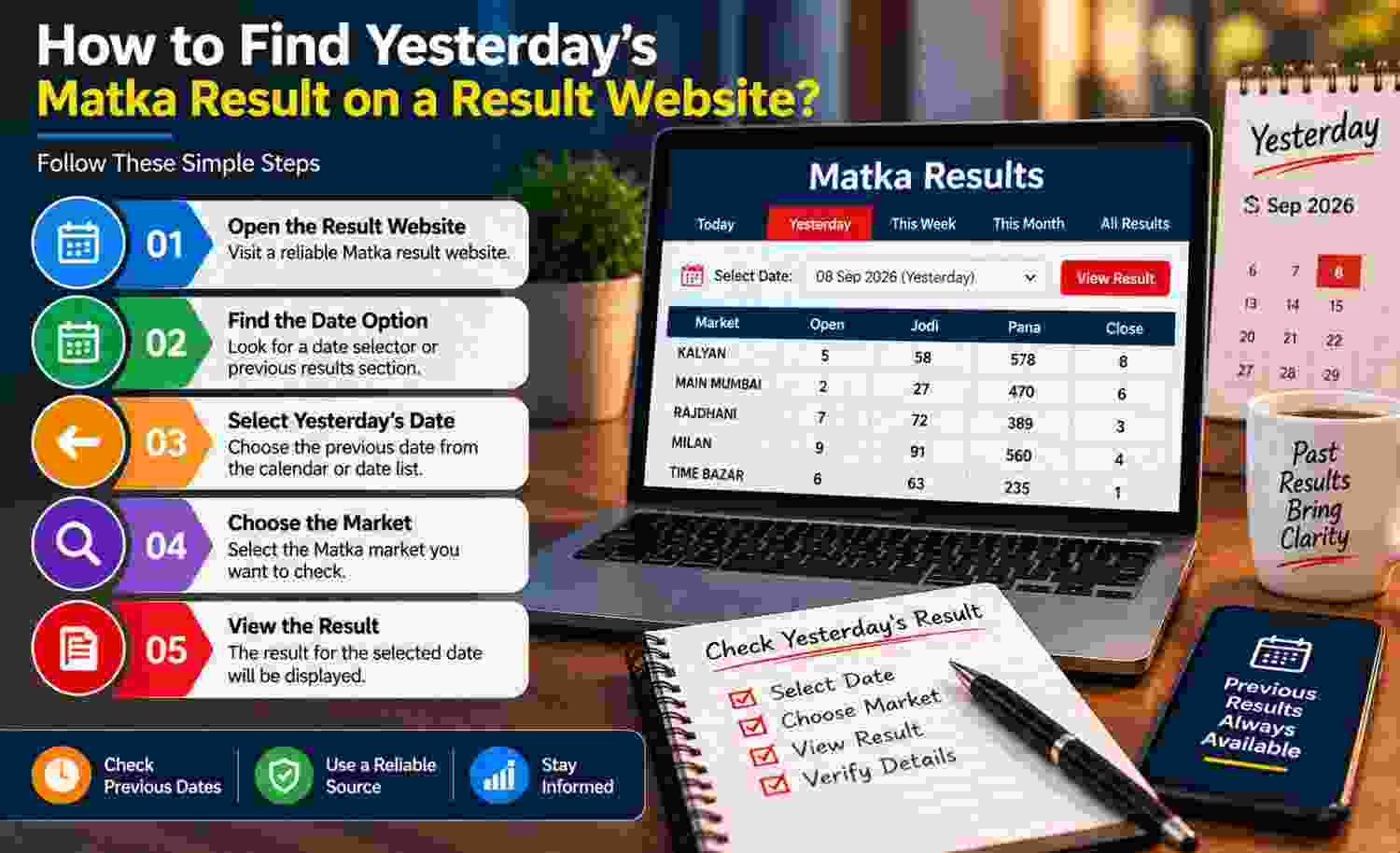
Finding a Matka result from the immediately preceding calendar day can be confusing when a result page prioritises newer entries, separates markets, or moves older records into archives. The safest approach is to identify the target date first, then confirm the market name, session, result field, and update status attached to that date. Because result websites can organise current and historical information differently, readers should rely on clear labels rather than screen position alone. A structured search process makes it easier to locate the correct previous-day entry without mixing it with the latest result or an older record.
What a Previous-Day Result Means
A previous-day result refers to an entry assigned to the calendar date immediately before the current date shown by the reader's local calendar. However, result pages may group information by market schedule, session type, or publication sequence, so the relevant entry may not always sit directly below the newest result.
The date attached to the market record matters more than the order in which a page loads sections. A previous-day entry can appear on the main page, inside a historical block, or within a date-based archive.
Check the Complete Result Context
Before treating any entry as the correct previous-day record, verify several details together:
- the market name;
- the calendar date;
- the session label;
- the opening or closing field, where shown;
- the completion or pending status;
- the location of the entry within current or historical sections.
Start by Checking the Calendar Date
The displayed date should be the first point of verification. Result pages may show dates in full written form, abbreviated form, or numeric format. Therefore, readers should identify the intended previous calendar date before scanning result fields.
Watch for Ambiguous Date Formats
Numeric dates can create confusion when both the day and month could be interpreted differently. To determine the format, examine neighbouring dates and any month or year heading.
Useful clues include:
- whether dates increase by one day;
- whether a month name appears nearby;
- whether older records follow the same pattern;
- whether the year is displayed once for an entire archive section.
Confirm the Correct Market Name
A result page may contain several market listings, often arranged in rows, cards, tabs, or separate sections.
Identify the market heading first, then follow that market's own date sequence. This becomes especially important on mobile layouts, where columns may stack and place neighbouring markets farther apart than they appear on desktop.
Why Visual Position Can Mislead
Responsive design can change the position of cards, labels, and result fields. An entry that appears beside a market name on a wide screen may move below another section on a smaller device.
Therefore, rely on written labels and structural grouping rather than colour, position, or spacing.
Look Below the Latest Result Section
Many result pages give priority to the newest entries. Consequently, the previous-day result may appear immediately below the latest result or after several session-specific entries from the current date.
When the Previous Date Is Not Visible
If the main page shows only a limited number of recent entries, earlier information may have moved into an archive or historical section. Do not assume the result is absent merely because it is missing from the first screen.
Look for navigation elements associated with older records, such as archive links, history sections, pagination, date selectors, or month-based navigation.
Use Historical or Archive Sections
Historical sections store earlier result information separately from the newest entries.
A previous-day result may move into such a section when the page refreshes or when a new date becomes active.
Common Archive Structures
Archive organisation can vary, but readers may encounter:
- daily history lists;
- weekly record groups;
- monthly archive sections;
- year-based collections;
- expandable date blocks;
- pagination;
- separate market histories.
When a page mentions DPBoss Matka in surrounding text, that wording does not replace the need to confirm the actual market label, date, session, and field attached to the archived record.
Check the Chronological Direction
Archive pages can run newest-to-oldest or oldest-to-newest. Failing to identify that direction can send readers away from the intended date.
If dates become earlier as the page moves downward, the list uses descending order. If they become later, it uses ascending order.
Why Chronology Matters
Chronological direction affects several tasks at once. It determines where the previous date is likely to appear, whether pagination moves towards older or newer records, and how consecutive dates should be interpreted.
Once the direction is clear, navigation becomes more predictable and less dependent on trial and error.
Use Date Filters Where Available
Some result pages provide date pickers, calendars, dropdowns, search fields, or archive selectors. These controls can shorten the search when the intended previous date is not visible in the current list.
Common Date-Navigation Controls
Useful controls may include:
- calendar icons;
- day or month dropdowns;
- date-range selectors;
- archive month links;
- year selectors;
- text-based date search;
- next and previous navigation arrows.
Check Morning, Day, Evening, and Night Sessions
A single calendar date may contain several session-based entries. Morning, daytime, evening, and night labels can therefore affect which result belongs to the previous day.
The session name should be checked before any numerical field is read. Otherwise, an evening record may be mistaken for a morning record simply because both appear under the same date.
Multiple Sessions Under One Date
When several sessions share one date heading, treat each session as a separate information block. Check:
- the session label;
- the market name;
- the result field;
- any opening or closing label;
- the status of that session.
This approach keeps the date context intact while preventing unrelated sessions from being combined.
Distinguish Opening and Closing Entries
Some market listings divide a date into opening and closing information. A previous-day search should therefore identify which field the page presents rather than treating every value under the date as interchangeable.
Why Field Type Matters
Opening and closing fields can occupy neighbouring columns, stacked boxes, or separate lines. On mobile pages, those fields may rearrange vertically, making the association less obvious.
Readers should follow labels instead of assuming that the first or second visible value always represents the same field across different layouts.
Latest Result Versus Previous-Day Result
The latest result is the most recently displayed completed entry on a page. A previous-day result, by contrast, is defined by its assigned calendar date.
If no newer entry has appeared, the previous-day record might still be the latest completed result. Conversely, several current-date sessions may appear after it.
Use Dates Rather Than Recency Labels
Labels such as latest, recent, or updated can help with navigation, but they should not replace the date check. The correct previous-day entry must carry the intended calendar date, regardless of where it appears in a recent-results section.
How to Read a Date-Based Result Row
A result row or card often contains several pieces of contextual information. Reading them in a consistent order reduces mistakes, particularly when multiple markets use similar formatting.
Look for:
- market name;
- calendar date;
- session category;
- opening field;
- closing field;
- result status;
- update time, where displayed.
How Mobile Pages May Organise Earlier Entries
Mobile result pages often convert wide tables or multi-column layouts into vertical cards. As a result, historical information may require more scrolling, and fields that appeared side by side on desktop may stack beneath one another.
Mobile Navigation Checks
On a smaller screen, readers can improve accuracy by:
- confirming the market heading after expanding a section;
- checking the date before scrolling further;
- watching for sticky headers that may hide labels;
- expanding collapsed historical blocks;
- using pagination controls at the bottom of the page;
- reopening the market heading after changing a date filter.
These checks help preserve context during longer scrolling sessions.
What to Do When the Previous-Day Result Is Missing
A missing entry does not have one universal explanation. The page may show a blank field, a pending label, an unavailable marker, or no record at all.
Possible page-level situations include delayed publication, an entry moving into an archive, an unavailable session, or a page-update difference. Without explicit status information, the safest interpretation is simply that the expected record is not visibly available.
Check Nearby Context Before Concluding
Before treating an entry as missing, examine:
- adjacent dates;
- session labels;
- archive sections;
- pagination;
- status markers;
- date filters;
- the market heading.
Check Whether the Result Has Been Updated
Update indicators can help readers determine whether a previous-day record is complete or still awaiting publication. However, an update timestamp and a result date serve different purposes.
A page-level update time may describe the entire page, while an entry-specific timestamp may refer only to one record.
Signs of a Completed Update
Depending on the layout, a completed entry may show:
- a populated result field;
- a completed status label;
- an entry-specific update time;
- movement from a pending section into historical records;
- removal of a placeholder.
Common Mistakes When Looking for an Earlier Result
Most retrieval errors come from losing context while moving through a dense page. Similar labels, repeated dates, and stacked mobile layouts can make unrelated records appear connected.
Common mistakes include:
- checking the wrong calendar date;
- confusing the latest entry with the previous-day record;
- selecting the wrong market;
- overlooking the session label;
- mixing opening and closing fields;
- reading an update timestamp as the result date;
- ignoring archived sections;
- following the wrong chronological direction;
- treating a blank field as a confirmed result;
- overlooking pagination.
Avoiding these errors depends on keeping the market, date, and session connected throughout the search.
A Simple Previous-Day Result Search Process
A consistent retrieval sequence can make navigation faster and clearer.
- Identify the immediately preceding calendar date.
- Open the relevant result section.
- Confirm the market name.
- Determine whether dates run newest-to-oldest or oldest-to-newest.
- Locate the intended previous date.
- Identify the relevant morning, day, evening, or night session.
- Separate opening and closing fields where applicable.
- Check whether the entry appears complete, pending, blank, or unavailable.
- Search the archive or historical section if the main page does not show it.
- Recheck the market name and date before reading the displayed information.
This sequence focuses entirely on locating and interpreting published result information.
Conclusion
Finding a previous-day Matka result depends on preserving context while navigating dates, markets, sessions, archives, and status information. Start with the intended calendar date, confirm the market name, identify the session and field type, and determine the page's chronological direction. If the entry is missing from recent results, check historical sections, filters, pagination, or archive links. Update timestamps should remain separate from result dates, while blank fields should not be treated as completed records. A consistent retrieval sequence helps readers locate earlier published information accurately across different result-page layouts.
FAQs
1. Where are previous-day Matka results usually located?
Previous-day results may appear directly below newer entries, inside a historical section, or within a date-based archive. The exact location varies by page structure. Start with the current result area, then check archive links, pagination, or date selectors if the immediately preceding calendar date is not visible.
2. How do I identify the correct previous date?
Determine the calendar date immediately before the current date, then match that date exactly on the result page. Check whether the site uses written or numeric date formatting. If the format seems ambiguous, compare neighbouring dates and any month or year heading before selecting the entry.
3. Why should I check the market name first?
Several market listings can display the same calendar date, so a date match alone does not identify the correct record. Confirm the market heading before reading any session or result field. This step also prevents mistakes when mobile layouts stack previously separate markets into one long vertical sequence.
4. Do previous results always move into an archive?
No. Some pages keep several recent dates on the main screen, while others move earlier records into historical sections quickly. The organisation depends on the page design. If the intended date is not visible among recent entries, check archive links, history sections, pagination, or date-based navigation.
5. How does chronological order affect the search?
Chronological order determines which direction leads towards the previous date. In descending lists, newer dates appear first and older dates follow. In ascending lists, the order runs the opposite way. Compare adjacent date labels before scrolling so you do not move towards later records when seeking an earlier one.
6. What should I do if the previous-day entry is blank?
Treat a blank field as incomplete or unavailable unless the page provides a clearer status. Check for pending labels, archive movement, session information, neighbouring dates, and update indicators. Do not assume that a blank space represents a completed result or that another market's entry explains the missing information.
7. How do session labels affect previous-day results?
One date may contain morning, daytime, evening, night, or other session categories. Confirm the relevant session before reading its result field. Two entries under the same date can represent different periods, so matching only the calendar date may lead to confusion about which record belongs to the intended session.
8. How are opening and closing fields different when searching?
Opening and closing labels identify separate result fields within some market listings. When both appear under one date, keep them distinct and follow the labels provided by the page. Mobile layouts may stack these fields, so their screen position should not replace the written field name as the main identifier.
9. Is an update timestamp the same as the result date?
No. The result date identifies the calendar day assigned to the record, while an update timestamp may show when an entry or page changed. A page-wide timestamp may not refer to one market specifically. Use the labelled result date as the primary reference for locating the previous-day entry.
10. How can mobile users find older results efficiently?
Mobile users should confirm the market heading before scrolling, expand collapsed history sections, check archive buttons, and use date selectors or pagination where available. Because wide layouts often become vertical cards, recheck the date and session after each navigation step so fields from neighbouring markets do not become mixed.