
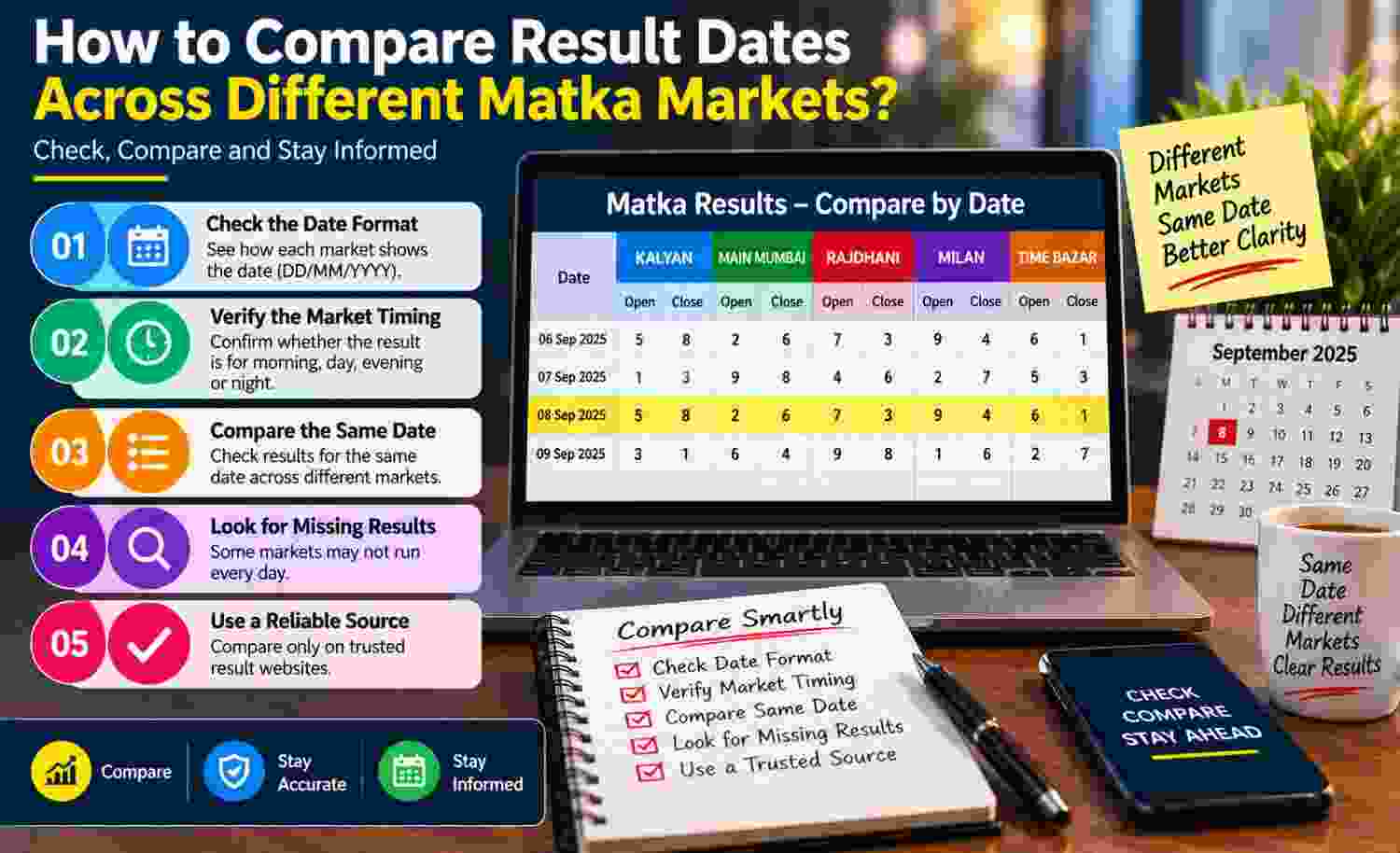
Comparing result dates across different Matka market listings can become confusing when market names, session labels, date formats, publication schedules, and archive structures differ. A result date only becomes meaningful when readers connect it with the correct market and session. Some listings separate opening and closing information, while others group entries by day, week, or month. Therefore, accurate comparison depends on reading the page structure carefully rather than matching numbers by position alone. A consistent method helps readers distinguish current records from historical entries, identify missing information, and compare equivalent result fields across several market listings.
What a Result Date Represents Across Different Markets?
A displayed result date identifies the calendar day assigned to a published market entry. However, that date should never be read in isolation. Readers must connect it with the market name, session label, result field, and any timing information shown nearby.
Different markets may operate under separate schedules or publication patterns. Consequently, two market listings can show information differently for the same calendar date without either layout being incorrect. One listing may present separate opening and closing fields, while another may use a single session block or multiple time-based sections.
The safest approach is to treat each entry as a complete information unit containing several elements:
- market name;
- calendar date;
- session or timing category;
- opening, closing, or other labelled field;
- result status;
- archive or current-section position.
Why Market Dates and Schedules Can Differ
Separate Matka markets can follow different operating periods, result sessions, and publication routines. Therefore, readers should not assume that every market produces entries at the same time or follows identical daily patterns.
Schedule Differences Affect Comparison
A schedule difference can change how a date should be interpreted. For example, one market may have a completed entry for a particular day while another market shows no result field for that same date.
Readers should therefore compare dates alongside:
- the displayed market name;
- the session category;
- the status of the entry;
- the field type being shown;
- the chronological context.
A result page that mentions DPBoss Matka within descriptive content still requires these structural checks because surrounding text cannot replace the actual market, date, and session labels attached to each record.
Start With the Market Name Before Comparing Dates
The market name is the first reference point in any date comparison. Similar-looking rows or columns can belong to different markets, especially when a page places several listings close together.
Readers should first identify the exact market heading and then trace the date within that market’s own section. This prevents accidental comparison of neighbouring records that merely share the same visual position.
Why Position Alone Is Unreliable
Position can change across desktop and mobile layouts. A market displayed in the first column on a wide screen may move lower on a smaller device. Likewise, archive sections may reorder or group entries differently.
Therefore, readers should rely on written labels rather than visual placement. A practical sequence is simple:
- Identify the market name.
- Confirm the date below or beside it.
- Locate the session label.
- Check the corresponding result field.
- Note whether the entry is current, archived, pending, or unavailable.
How to Compare the Same Calendar Date Across Markets
Once the correct markets are identified, readers can compare the same calendar date by locating that date independently within each listing. The aim is to match equivalent records rather than entries that only appear on the same row.
A Clear Date-Matching Process
The following sequence keeps comparisons organised:
- Select the first market listing.
- Locate the intended calendar date.
- Confirm the displayed date format.
- Identify the relevant session.
- Check whether the field represents opening, closing, or another labelled category.
- Repeat the same steps for the second market.
- Compare only equivalent fields.
- Check for pending, blank, or unavailable status markers.
- Confirm whether both entries appear in comparable current or historical sections.
- Recheck the market names before drawing any informational comparison.
Check Date Formats Carefully
Date formatting can create avoidable mistakes. Some listings may use a day-month-year order, while others may display the month in words or shorten the year. Numeric-only dates can be especially ambiguous when both the day and month contain values that could be read either way.
Readers should use surrounding records to identify the page’s pattern.
Common Date Presentation Styles
Result pages may use formats such as:
- full written dates;
- abbreviated month names;
- numeric day-month-year order;
- month-and-day labels;
- day-and-month entries within a monthly archive.
Because presentation conventions vary, readers should not assume that the same numeric sequence carries the same meaning everywhere. A month heading can also change the interpretation of a shorter date label.
Compare Sessions Alongside Result Dates
A calendar date may contain several session-based entries. Morning, daytime, evening, and night labels can separate results by time period, while opening and closing labels can divide information within a market’s own session structure.
Opening and Closing Information
Opening and closing fields should be compared only with equivalent fields. An opening entry from one market should not be treated as directly equivalent to a closing entry from another simply because both share the same date.
Likewise, a morning entry should not be matched automatically with a night entry.
Readers should identify:
- session label;
- field label;
- date;
- market name;
- completion status.
Result Date Versus Update Time
A result date and an update timestamp serve different purposes. The result date identifies the calendar day assigned to the market record, while an update time may indicate when the page or entry changed.
How to Read Update Information
An update indicator may appear beside an individual entry or at page level. If it sits near a specific record and clearly refers to that record, readers can treat it as entry-specific information.
However, a general page timestamp may apply to the entire page. It should not automatically replace the result date or prove when a particular market record appeared.
Comparing Current and Historical Records
Current sections and historical archives serve different navigational purposes. A current section usually prioritises recent entries, while an archive stores earlier dates in an organised sequence.
Recognising Historical Sections
Historical records may appear beneath month headings, year headings, expandable lists, or separate archive sections. Common signs include:
- older date ranges;
- monthly grouping;
- pagination;
- year selectors;
- archive labels;
- repeated historical session blocks.
Using Chronological Order for Date Comparison
Chronological direction affects navigation. Some result lists place the newest dates first, while others begin with older dates and move forward.
Readers should inspect several consecutive entries before assuming the order.
Ascending and Descending Records
Ascending order moves from earlier dates towards later ones. Descending order does the opposite and usually brings newer entries closer to the top.
Neither approach creates a problem when the layout remains consistent. Confusion occurs when readers expect one direction, and the page uses another.
Comparing Consecutive Result Dates
Consecutive-date comparison helps readers examine how records are organised across successive calendar days. The main risk is drifting into another market or session while moving vertically or horizontally through a dense listing.
A Reliable Consecutive-Date Method
For each market:
- confirm the market heading;
- note the first date;
- move to the immediately preceding or following date according to the page order;
- verify the session label remains the same;
- check whether any entry is blank or unavailable;
- repeat the sequence in the comparison market.
Weekly and Monthly Records Make Comparison Easier
Weekly and monthly groupings can simplify historical comparison because they provide broader date context. A month heading, for example, helps readers interpret short day labels without repeatedly checking the year or month.
Similarly, weekly blocks can make consecutive dates easier to follow.
Benefits of Grouped Archives
Well-organised weekly or monthly records can help readers:
- locate a date range quickly;
- identify missing dates more easily;
- compare repeated session labels;
- follow chronological direction;
- distinguish older records from current entries;
- reduce confusion caused by isolated date rows.
Missing, Blank, or Unavailable Result Dates
A market listing may show a blank field, unavailable marker, pending status, or no visible entry for a date. Readers should not treat these states as equivalent without contextual information.
A blank area may reflect unpublished information, a delayed update, a non-applicable session, or another page-specific condition.
How to Interpret Missing Information Carefully
When an expected entry is absent, readers should check:
- whether the date appears elsewhere in the same market section;
- whether another session is listed;
- whether the field carries a pending or unavailable label;
- whether the page has shifted into an archive;
- whether neighbouring dates follow the same pattern.
The absence of a displayed result should remain an absence unless the page supplies clearer status information.
Delayed Updates and Date Comparison
Delayed publication or page refreshing can affect how records appear. One market may show a completed entry while another still displays a blank or pending field for the same calendar date.
Readers should avoid treating that difference as proof that the second market lacks a result permanently.
Instead, status labels and entry-specific update indicators should determine how the page is read.
Why Update Timing Matters
If a page clearly shows an update time, readers can use it to assess whether the displayed record has changed. Nevertheless, the update time remains separate from the assigned result date.
A later update does not necessarily create a new result date. Therefore, date comparison should continue to rely on the date attached to the market record itself.
Common Date-Comparison Mistakes
Many comparison errors come from page reading rather than from the underlying records. Dense layouts, repeated dates, similar labels, and mixed archives can make neighbouring information appear related when it is not.
The most common mistakes include:
- comparing different market names;
- confusing result dates with update timestamps;
- overlooking session labels;
- reading the wrong row or column;
- mixing current and historical records;
- overlooking different date formats;
- assuming every market follows an identical schedule;
- treating a blank entry as a confirmed result;
- comparing opening information with closing information;
- overlooking chronological direction.
Avoiding these errors requires structural reading rather than visual guesswork.
A Practical Date-Comparison Checklist
A short checklist can help readers verify that they are comparing equivalent records across several market listings.
Before accepting a comparison, confirm the following:
- The market names are correct.
- The calendar date matches.
- The date format has been interpreted correctly.
- The session category is equivalent.
- The result field represents the same type of information.
- Opening and closing fields have not been mixed.
- Both records belong to comparable current or historical sections.
- The chronological direction is clear.
- Blank or pending entries remain identified as incomplete.
- Update timestamps have not been mistaken for result dates.
This process keeps the comparison focused on page organisation and published information.
Conclusion
Accurate result-date comparison depends on matching more than calendar dates. Readers should verify the market name, session, field type, date format, archive position, chronological direction, and update status before comparing records. Different markets can follow different schedules and presentation patterns, so equivalent entries must be identified through labels rather than assumed from visual position. Blank or delayed fields should remain separate from completed records until clearer status information appears. By following a consistent reading sequence, readers can compare current and historical Matka result dates more accurately without confusing unrelated markets, sessions, or timestamps.
FAQs
1. How can I compare the same date across two Matka markets?
Start by identifying each market name separately, then locate the same calendar date within both listings. Check the session label and result field before comparing anything. If one entry represents a different session or field type, treat the records as non-equivalent even when the displayed date matches.
2. Why can two markets show different result schedules?
Different markets may follow separate operating periods, session structures, or publication routines. Therefore, one listing may show information for a date when another does not. Readers should rely on each market’s displayed labels and status information rather than assume that all listings follow one common schedule.
3. How should I read different date formats?
Check surrounding entries to identify the page’s date pattern. A written month usually removes ambiguity, while numeric-only formats may require more care. Compare neighbouring dates and any month or year heading before deciding how the sequence should be read, especially when day and month positions could be confused.
4. Why do session labels matter when comparing dates?
A single calendar date can contain more than one session. Morning, daytime, evening, night, opening, or closing labels identify which part of the listing a result belongs to. Matching dates without matching sessions can place two different records side by side and create an inaccurate comparison.
5. How can I compare historical dates accurately?
First, identify the correct archive period, such as the relevant month or year. Then locate the market, date, and session within that section. Confirm whether the archive runs forward or backward chronologically. Historical comparison works best when both entries come from equivalent archive structures and matching field categories.
6. What does a missing date entry mean?
A missing entry does not have one universal meaning. It may reflect unavailable, unpublished, delayed, or non-applicable information, depending on the page. Readers should look for nearby status labels, session information, and neighbouring date patterns before interpreting the absence. Without clearer context, treat the field simply as missing.
7. Can delayed updates affect date comparisons?
Yes. One market may show a completed record while another still appears blank or pending for the same date. Readers should distinguish publication status from the assigned result date. A delayed update changes what is visible at that moment, but it does not automatically change the calendar date attached to the record.
8. How do I identify chronological order on a result page?
Compare two or three neighbouring date entries. If dates move from earlier to later as you go down the page, the list uses ascending order. If newer dates appear first, it uses descending order. Confirming this direction helps prevent accidental comparison of non-consecutive records or incorrect archive positions.
9. What is the difference between a result date and an update timestamp?
The result date identifies the calendar day assigned to a market record. An update timestamp indicates when a page or entry may have changed. These values serve different purposes. For date comparison, rely primarily on the labelled result date and use update information only as supporting context.
10. How can I avoid common comparison errors?
Verify the market name, calendar date, date format, session label, field type, archive position, and chronological direction before comparing entries. Keep blank or pending fields separate from completed records. Finally, confirm that update timestamps have not been mistaken for result dates and that opening and closing information remain distinct.