
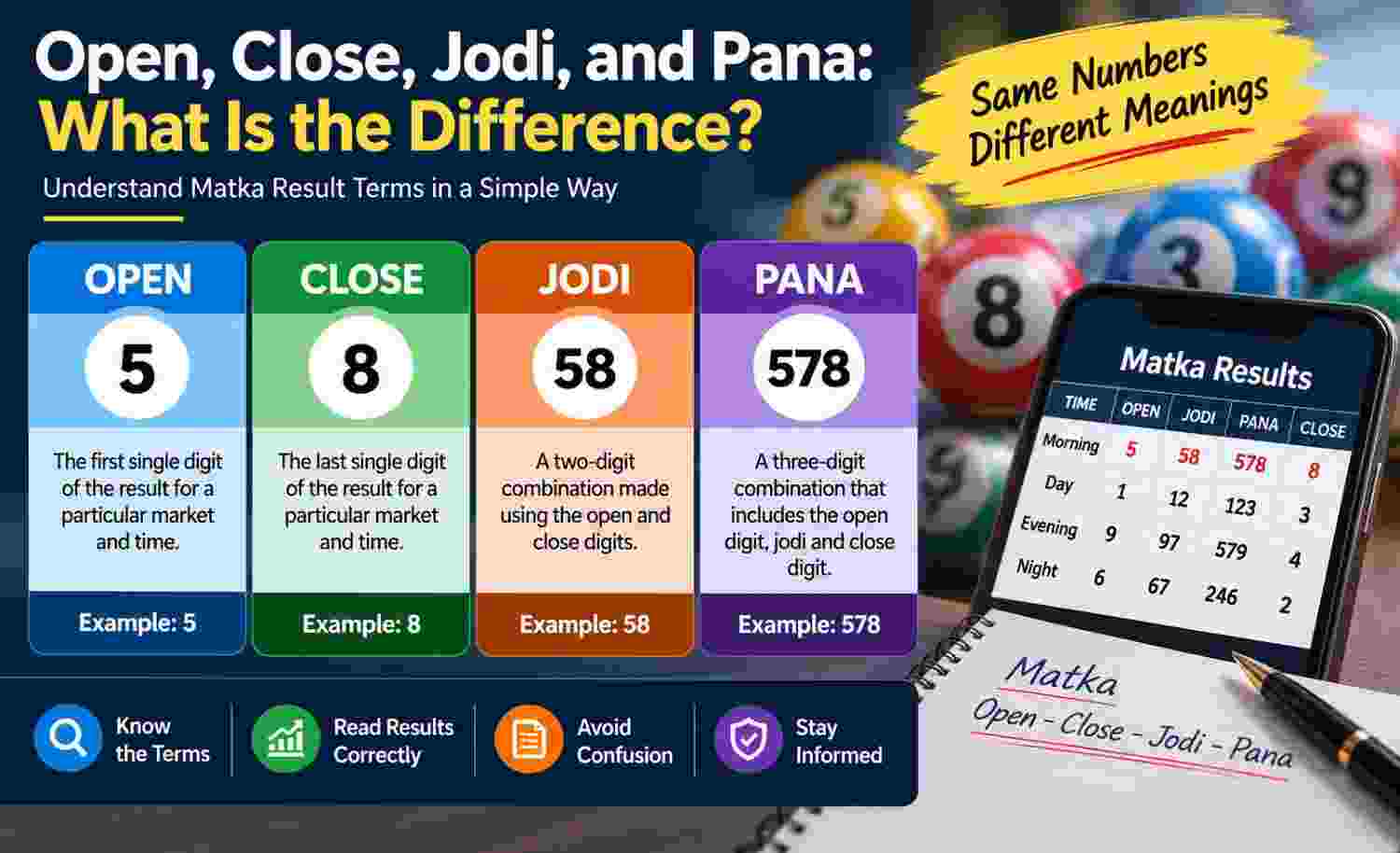
Matka result pages often place Open, Close, Jodi, and Pana information within the same market block, which can make distinct fields appear interchangeable. They are not interchangeable labels. Each identifies a different part or representation of published result information, and its meaning depends on the surrounding market, date, session, and field headings. Layouts can also vary, so position alone is not a reliable identifier. Accurate reading starts with the visible labels and their relationship to the relevant result entry. Recognising these distinctions helps prevent confusion between separate fields, incomplete entries, adjacent markets and historical records.
Why Do These Result Terms Need Separate Reading?
Result terminology works as an information structure. Open and Close generally identify separate result stages or fields, while Jodi and Pana represent different displayed result forms associated with the published record. The precise presentation can vary between pages and markets.
Consequently, a reader should not assume that two fields mean the same thing simply because they appear beside each other. Labels, alignment and completion status provide the necessary context.
Four Labels, Four Informational Roles
At a high level, the distinctions can be summarised as follows:
- Open identifies an opening-side result field or stage.
- Close identifies a closing-side result field or stage.
- Jodi identifies a paired result representation formed from the published opening and closing sides.
- Pana identifies a three-digit result representation associated with a result side or stage.
What Does Open Mean?
Open generally identifies the opening part of a published Matka result structure. On a result page, it may appear as a clearly labelled field, a column, a session-related entry, or part of a combined result line.
How Open Information May Appear
Page designs differ, so Open information can be presented in several ways. Common structures may include:
- a dedicated Open column;
- a labelled field within a market row;
- an opening-side block;
- part of a wider combined record;
- a blank or pending field before completion.
A visible value should always be connected to its label, market, and date before interpretation. Adjacent numbers may belong to another field.
What Does Close Mean?
Close generally identifies the closing part of a published result structure. It is distinct from Open even when both appear within the same market, date, or row.
Some layouts place the fields side by side; others separate them vertically. Therefore, their visual proximity does not make them interchangeable.
Why Open and Close Should Not Be Confused
Several page cues help separate the two fields:
- explicit Open and Close labels;
- different column positions;
- session or stage headings;
- alignment within the market row;
- individual completion indicators.
Moreover, one field can appear complete while another remains blank or pending. In that situation, the incomplete field should not be inferred from the completed one. The page must display each field clearly before it can be treated as published information.
What Does Jodi Mean?
Jodi generally refers to a paired result representation associated with the opening and closing sides of a completed result. On result pages, it may be shown as its own labelled field or incorporated into a combined display.
The important distinction is structural: Jodi is not simply another name for either Open or Close. It represents a separate result element derived from the published pair of sides.
How Jodi Differs From Open and Close
Open and Close identify separate sides or stages. Jodi represents their paired result form once the relevant information is available.
A page mentioning DPBoss Satta in surrounding informational text still requires the reader to verify the Jodi label, market, date, and row because descriptive text does not determine which displayed field is being viewed.
Where one side remains incomplete, a related combined field may also be absent or pending. Readers should rely on the page status rather than fill in missing information themselves.
What Does Pana Mean?
Pana generally refers to a three-digit result representation displayed in Matka result terminology. Depending on the result structure, a page may associate a Pana field with an opening or closing side and show it separately from Jodi.
This definition concerns how published information is identified. It does not require calculating combinations or deriving any future value.
How Pana Differs From Jodi
Pana and Jodi describe different forms of result information. Pana is typically a three-digit representation associated with a result side, whereas Jodi is a paired representation associated with the opening and closing sides.
Consequently, a reader should use the field heading rather than the number of visible characters alone. Formatting, separators, and responsive layouts can change how values look on screen.
Open Versus Close
The clearest difference is their role within the result sequence: Open identifies the opening side, while Close identifies the closing side. Both may belong to the same market and calendar date but occupy different fields.
What to Compare on the Page
Before distinguishing them, check:
- the field heading;
- the market row;
- the calendar date;
- the relevant session or stage;
- whether each field is complete;
- whether mobile stacking has changed their position.
A common reading error occurs when a value visually shifts beneath the wrong heading on a narrow screen. Explicit labels remain more dependable than remembered desktop positions.
Jodi Versus Pana
Jodi and Pana should also remain conceptually separate. Jodi presents a paired result form linked to the opening and closing sides, while Pana presents a three-digit form associated with a result side.
Their labels communicate different informational roles even if a page displays them within one combined record.
Why Formatting Can Create Confusion
Dense result rows may use limited spacing, abbreviated headings, or several numerical fields. Consequently, a Jodi field can appear close to a Pana field without belonging to the same column or stage.
Readers should trace each displayed value back to its heading. If the page uses expandable blocks, expand the relevant market before associating a field with a label.
Comparing All Four Fields Together
The four terms become easier to distinguish when each is treated according to its function rather than its position on a particular page.
In practical result-page terms:
- Open identifies the opening-side field.
- Close identifies the closing-side field.
- Jodi identifies a paired representation associated with both sides.
- Pana identifies a three-digit representation associated with a side or stage.
Why the Market Name Still Matters
A field label has meaning only within the correct market context. Result pages may place several markets in consecutive rows, columns, or cards, making accidental cross-reading possible.
Before reading Open, Close, Jodi, or Pana information, locate the market heading and follow its visual boundary to the relevant fields.
Avoid Adjacent-Market Errors
Check whether:
- the market name sits above or beside the field;
- a border separates neighbouring markets;
- the row continues horizontally;
- mobile stacking has moved another market underneath;
- an expanded section belongs to the intended market.
This prevents a correctly identified field from being attached to the wrong market.
Why the Calendar Date Matters
The same field labels can repeat every day across current and historical records. Therefore, identifying Open or Jodi correctly is insufficient if the associated date is wrong.
Result pages may show adjacent dates, grouped archives, or multiple daily entries.
Check Date Context Before the Field
Confirm the calendar date first, including the month and year where needed. If the page uses abbreviated dates, compare neighbouring entries to establish the format.
Additionally, do not confuse a page-update timestamp with the date assigned to the result record.
How Session Labels Affect Interpretation
Session labels provide another layer of organisation. Depending on the market and page structure, results may be grouped by morning, daytime, evening, night, opening, closing or other page-specific descriptions.
No single session naming pattern applies universally.
Connect Session and Field Labels
A result field should be read within its session block. If the same market has several sessions, identify the relevant session before moving to Open, Close, Jodi or Pana.
Likewise, a session heading should not be treated as a field heading. The two labels perform different organisational functions.
How Result Pages May Arrange the Fields
Result pages can organise information vertically, horizontally, or through expandable components. Desktop and mobile versions may also rearrange the same content.
Common Layout Patterns
Possible arrangements include:
- adjacent columns;
- vertical market listings;
- separate result blocks;
- stacked mobile cards;
- expandable sections;
- date-based archive rows;
- combined result lines.
A horizontal desktop row, for example, may become several stacked lines on mobile. Recheck headings after any layout change.
What an Incomplete Field Means
Blank, pending, incomplete, or unavailable fields indicate that the page does not currently present a complete entry in that position. The precise reason may not be stated.
A missing field should never be treated as though a final value has already appeared.
Signs That More Information May Be Pending
Depending on the page, indicators can include:
- an empty field;
- a pending label;
- a placeholder;
- only one completed side;
- an unavailable status;
- a partially populated record.
These states should be interpreted according to the visible page labels rather than assumptions about publication timing.
Result Date Versus Update Timestamp
A result date identifies the calendar period assigned to an entry. An update timestamp, where displayed, identifies when a page or specific block may have changed.
The two serve different purposes.
Why Timestamp Confusion Matters
A later update time does not automatically move a result into another calendar record. Conversely, a general page timestamp may apply to several sections rather than one field.
Use the market and result-date labels as the primary context, then treat timestamps as supplementary status information.
Common Mistakes When Reading These Terms
Most interpretation errors arise from losing the relationship between a field and its surrounding labels.
Frequent mistakes include:
- treating Open and Close as one field;
- confusing Jodi with Pana;
- selecting the wrong market;
- reading the wrong date;
- overlooking a session heading;
- crossing into an adjacent row or column;
- treating a pending field as complete;
- overlooking historical records;
- confusing an update timestamp with a result date;
- missing fields hidden by mobile formatting;
- comparing different field types across markets.
The corrective principle is simple: interpret every value only after identifying its exact label and context.
A Simple Result-Field Verification Process
A consistent verification sequence reduces errors across different layouts.
Follow these steps:
- Confirm the market name.
- Check the calendar date.
- Identify the relevant session or result section.
- Locate the exact field heading.
- Determine whether it identifies Open, Close, Jodi, or Pana.
- Read only the value directly associated with that heading.
- Confirm that the entry appears complete rather than pending.
- Check row and column alignment.
- Separate the result date from any update timestamp.
- Reconfirm the market, date, session, and field together.
This sequence concerns published information only and does not imply any use of the displayed result beyond accurate identification.
Conclusion
Open, Close, Jodi, and Pana identify different elements within Matka result information. Open and Close refer to separate result sides or stages, Jodi represents a paired result form, and Pana represents a three-digit result form associated with a side. Their presentation can vary across markets, dates, sessions, archives, and devices. Accurate interpretation therefore depends on reading each field within its complete context. Checking the market, calendar date, session, heading, alignment,t and completion status prevents common errors, particularly when fields appear adjacent, incomplete, archived, ed or rearranged on mobile screens.
FAQs
1. What is the difference between Open and Close?
Open generally identifies the opening side of a published result structure, while Close identifies the closing side. They may appear within the same market and date but occupy separate fields or stages. Their labels, alignment, and completion status should be checked independently because one field may appear before the other is complete.
2. Is Jodi the same as Open or Close?
No. Jodi generally represents a paired result form associated with the opening and closing sides, whereas Open and Close identify those sides separately. Result-page presentation varies, so Jodi may appear in its own field or within a combined line. The visible heading provides the clearest identification.
3. How is Pana different from Jodi?
Pana generally identifies a three-digit result representation associated with a result side or stage. Jodi represents a different paired result form associated with opening and closing information. Although both can appear in the same published record, they serve different informational roles and should be read through their individual field labels.
4. Can Open and Close appear separately on a result page?
Yes. A result layout may provide separate Open and Close columns, blocks, or labelled fields. Their information may also reach a completed state separately. Consequently, seeing one populated field does not establish that the neighbouring field is complete. Check each label and its visible status independently.
5. Why do result pages show several result fields?
Several fields allow a page to present distinct parts or representations of one market record without treating them as interchangeable. Open, Close, Jodi, and Pana labels help identify those differences. The exact arrangement varies, so market, date, session, and field headings remain essential for accurate result-page reading.
6. How can I identify the correct result field?
Begin with the market and calendar date, then identify the relevant session or result block. Locate the exact field heading and follow its row or column to the associated value. On mobile, recheck alignment after scrolling or expanding sections because responsive layouts may reposition fields and labels.
7. Why does the market name matter when reading these terms?
The same field labels can appear across several markets on one page. Without checking the market heading, a reader can correctly identify a field type but attach it to the wrong record. Confirm the market boundary, date, and session before associating any Open, Close, Jodi, or Pana field with an entry.
8. Can incomplete fields appear on result pages?
Yes. Depending on the page, a field may appear blank, pending, partially populated, or unavailable. Such a display does not provide a confirmed final entry for that field. Use visible status labels and completion indicators, and avoid inferring missing information from neighbouring fields or previously displayed records.
9. How do historical records display these terms?
Historical sections may preserve the same field labels used for current records, although their layout can differ. Archives may group information by date, month, or market and use ascending or descending chronology. Verify the archive period, market, session, date, and field alignment before reading an older entry.
10. Why can mobile layouts make result fields confusing?
Responsive layouts can stack columns, shorten headings, introduce horizontal scrolling, or place fields inside expandable blocks. These changes may weaken the visual relationship between a heading and its value. After scrolling or expanding content, confirm the market, date, session, and field label again rather than relying on desktop positioning.