
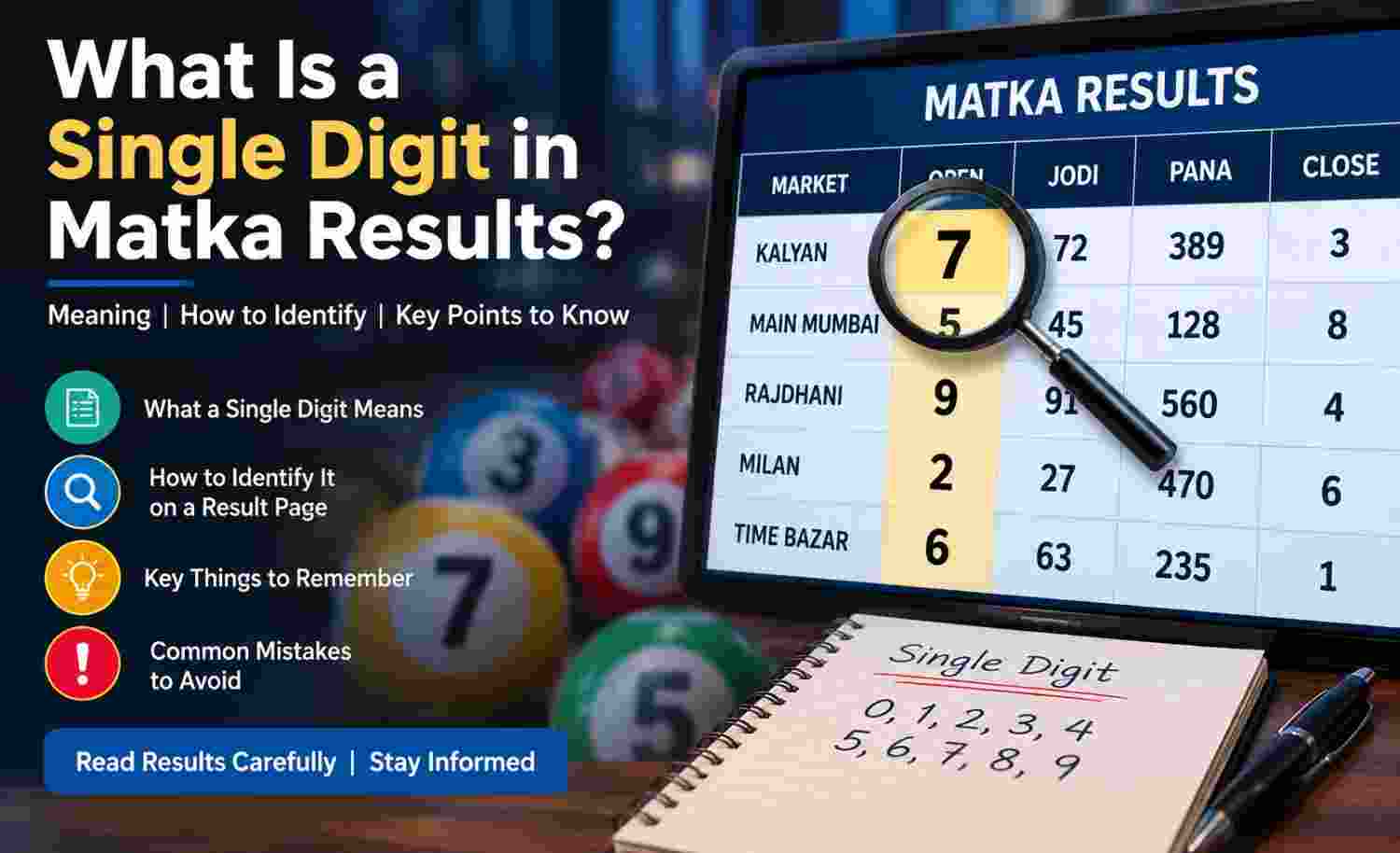
Matka result pages often display several numerical fields beside market names, dates, sessions, and status labels. A single digit is one such result format, but it can be misread when neighbouring values, Jodi fields, Pana fields, Open or Close sections, and historical records appear together. Correct interpretation depends on identifying the exact field rather than reading an isolated number. Because page structures vary, readers should verify the market, date, session, row, column, and completion status before treating any displayed digit as the intended published result.
What Is a Single Digit?
A single digit is a one-character numerical result field shown within Matka result information. In result-page terms, it represents one displayed digit rather than a multi-digit format such as Jodi or Pana.
A single digit identifies the displayed format, while surrounding labels show where that result belongs. The same field type can therefore appear under different markets, dates, or sessions.
Why It Is Called a Single Digit
The name describes the visual format of the field: one numerical digit is displayed. It does not describe a market name, a calendar date, or a session by itself.
A reader should therefore separate the format from the surrounding result information. The field may sit inside an Open or Close section, beside another result category, or within a historical record, depending on the page layout.
How a Single Digit May Appear on a Result Page
Result pages may present a single-digit field in several ways. Some layouts use dedicated columns, while others place the value inside a market card or session block.
Page designs differ, so Open information can appear in several ways:
- a dedicated single-digit field;
- a labelled result column;
- a value inside a session section;
- a field associated with Open or Close;
- a value displayed beside Jodi or Pana information;
- an entry preserved in a historical archive.
Layouts differ, so the label and surrounding structure matter more than screen position.
Where to Look for a Single-Digit Field
Identify the correct field by starting with the result context.
Look for the following information around the field:
- market heading;
- calendar date;
- session name;
- Open or Close heading where applicable;
- field label;
- row and column alignment;
- archive or current-result section.
If a page mentions DPBoss in surrounding descriptive text, that wording does not identify the single-digit field itself. The reader still needs to match the actual market, date, session, and result label attached to the displayed value.
This approach also helps when repeated digits appear nearby, because the label and context determine the field identity rather than the visual value alone on screen.
How a Single Digit Differs From a Jodi
A single digit and a Jodi are different result formats. A single digit contains one displayed numerical digit, whereas a Jodi is a separate paired result representation.
Labels still matter because responsive layouts can rearrange values.
Why the Two Formats Can Be Confused
Both may appear within the same market record or result block. If columns are narrow, headings abbreviated, or fields stacked on mobile, a reader may follow the wrong label.
Therefore, the correct approach is to identify the field heading first and then read only the value directly attached to it.
How a Single Digit Differs From Pana
A Pana is a different result format from a single digit. In published result information, Pana is typically shown as a three-digit representation, while a single digit contains one displayed digit.
This distinction concerns result structure.
Visual Differences Matter
A three-digit field may occupy more space or appear in another column, but layout alone is not enough for identification. Some pages compress several values into compact rows.
As a result, readers should use the Pana label, single-digit label, market name, and row alignment together before interpreting the visible information.
Single Digit Versus Open and Close
Open and Close generally describe separate result sides or stages, while a single digit describes the numerical format displayed within the relevant result context.
A single-digit field may therefore appear under an Open or Close heading.
Keep Stage Labels and Format Labels Separate
The distinction becomes easier when each label is assigned its own role:
- Open identifies an opening-side context.
- Close identifies a closing-side context.
- Single digit identifies a one-digit result format.
- Jodi identifies a different paired format.
- Pana identifies a different three-digit format.
These roles should not be treated as interchangeable.
Why the Market Name Matters
A result page can contain many markets, and the same field format may repeat across them.
Therefore, a correctly identified single-digit field can still be interpreted incorrectly if it belongs to the wrong market.
Avoid Cross-Row Reading
Start at the market heading and trace the same row or card towards the result field. If the page is dense, pause at each label rather than scanning across several markets in one movement.
On mobile, recheck the market name after scrolling because stacked layouts can separate headings from their associated values.
Why the Result Date Matters
Single-digit fields can repeat across dates, so selecting the wrong day can produce an incorrect entry.
A result date identifies the calendar period assigned to the record. It should be checked independently of page update information.
Watch Adjacent Dates Carefully
When several dates appear close together, confirm:
- the intended day;
- the month;
- the year where displayed;
- whether the record is current or historical;
- whether chronology runs forward or backward.
This prevents an older or newer single-digit entry from being mistaken for the intended one.
Why Session Labels Matter
Session labels can determine where a single-digit result appears.
No universal session naming pattern applies to every result page.
Match the Session Before Reading the Field
After verifying the market and date, identify the relevant session block. Then locate the single-digit field within that section.
If several sessions share one date, each should be treated as a separate information group rather than as interchangeable entries.
How to Read a Single Digit in the Correct Row
Dense result tables can make horizontal tracking difficult, causing readers to drift into a neighbouring row.
Use Row Alignment Deliberately
Check the market name, then follow the same horizontal or card-based structure towards the field. Borders, spacing, labels, and alternating sections can help.
If the row alignment is unclear, return to the market heading rather than guessing which value belongs to it.
How to Read a Single Digit in the Correct Column
Columns can also create problems when several formats appear together.
A single digit should be read from the column explicitly associated with that field.
Horizontal Scrolling Can Shift Context
On mobile devices, horizontal scrolling may move the column heading off-screen while leaving values visible. Consequently, readers can forget which field they are viewing.
Scroll back to the heading when necessary and confirm the column label before interpreting the number.
What a Blank Single-Digit Field Means
A blank field does not have one universal explanation. It may indicate that information is pending, incomplete, unavailable, not yet displayed, or temporarily absent from the current page state.
Without a completed value or clear status label, the field should remain classified as incomplete information.
Common Incomplete States
Depending on the page, readers may see:
- a blank space;
- a pending label;
- an incomplete marker;
- an unavailable status;
- a placeholder;
- a partially updated record.
None of these should automatically be treated as a confirmed final result.
Single Digit and Result Update Status
A result page may indicate updates through status labels, timestamps, populated values, or movement from pending to completed.
However, update conventions differ.
Check Completion in Context
Useful indicators can include:
- a populated single-digit field;
- a completed status;
- removal of a placeholder;
- an entry-specific update time;
- movement into a recent or archived result section.
A page-level timestamp may refer to the whole page rather than the individual field.
Result Date Versus Page Update Timestamp
The result date and the page update timestamp serve different purposes. The result date identifies the calendar day assigned to the record, while the update timestamp indicates when the page or entry may have changed.
Confusing the two can lead to selection of the wrong date.
Use the Result Date as the Primary Reference
When locating a single-digit entry, start with the market and result date. Treat update information as supporting context.
A later page update does not automatically create a new result date unless the page explicitly assigns the record to a different calendar day.
Current Single-Digit Results Versus Historical Records
Current sections prioritise newer records, while historical areas preserve older entries that may move into archives.
Archive Structures Can Differ
Earlier entries may appear in:
- daily history lists;
- weekly groups;
- monthly archives;
- market-specific records;
- paginated history;
- expandable older-result sections.
After entering an archive, verify the market, date, session, and field again because historical layouts may differ from current-result layouts.
How Chronological Order Affects Reading
Chronological direction determines whether newer or older records appear first.
Ignoring that order can lead to selecting an unintended single-digit result.
Newest-to-Oldest Listings
In descending order, newer dates appear first and older records follow. This structure often places the latest entry near the top.
Oldest-to-Newest Listings
In ascending order, older dates appear first, and newer records follow later. Compare adjacent dates before assuming which direction the page uses.
How Mobile Layouts Affect Single-Digit Display
Mobile designs may reorganise tables into stacked, expandable, or horizontally scrollable blocks.
These changes can weaken the visible connection between a field and its label.
Common Mobile Display Issues
Readers may encounter:
- stacked result fields;
- collapsed sections;
- truncated labels;
- narrow columns;
- horizontal scrolling;
- hidden headings;
- compact date displays;
- expandable market blocks.
After changing the mobile view, verify the market, date, session, and field label again.
Common Mistakes When Reading a Single Digit
Many interpretation errors come from reading a value without context.
Common mistakes include:
- checking the wrong market;
- selecting the wrong date;
- confusing one session with another;
- reading an adjacent row;
- selecting the wrong column;
- confusing a single digit with Jodi;
- confusing a single digit with Pana;
- treating a pending field as final;
- overlooking historical entries;
- confusing update time with result date;
- missing hidden mobile content;
- assuming every page uses the same field arrangement.
Accurate interpretation depends on keeping the field connected to all its surrounding labels.
A Simple Single-Digit Verification Process
A consistent sequence reduces errors across varied layouts.
Follow these steps:
- Confirm the correct market name.
- Check the calendar date.
- Identify the relevant session.
- Locate the exact result field.
- Confirm that the field represents a single digit.
- Read only the value directly associated with that field.
- Verify the correct row and column.
- Check whether the result appears complete rather than pending.
- Distinguish the result date from any page-update timestamp.
- Recheck the market, date, session, and field together.
This process concerns result-page interpretation only.
Conclusion
A single digit in Matka result information is a one-digit numerical field that must be read within its full result context. It differs from Jodi and Pana in format, while Open and Close describe separate result contexts where applicable. Accurate interpretation depends on verifying the market, calendar date, session, field label, row, column, chronological position, and completion status. Readers should also distinguish result dates from update timestamps and recheck mobile or archive layouts when labels shift. Keeping these elements connected prevents common mistakes and helps identify the intended published single-digit entry correctly.
FAQs
1. What does a single digit mean in Matka results?
A single digit refers to a one-digit numerical result field displayed within a market record. It differs from multi-digit formats such as Jodi or Pana. To identify it correctly, confirm the field label, market name, calendar date, session, and row or column connected to the displayed value.
2. How is a single digit displayed on a result page?
It may appear in a dedicated column, a labelled field, a session block, an Open or Close section, or beside other result formats. Layouts vary, so screen position alone is unreliable. Use the visible heading and surrounding market, date, and session information to identify the field correctly.
3. Is a single digit the same as a Jodi?
No. A single digit contains one displayed numerical digit, while Jodi is a separate paired result format. Both can appear within the same market record, which can create confusion. The safest distinction comes from checking the field heading and following the value attached to that specific label.
4. How is a single digit different from Pana?
A single digit displays one numerical digit, whereas Pana is typically presented as a three-digit result format. They serve different informational roles on a result page. Because compact layouts can place them close together, confirm the field label, row, market, and date before interpreting either value.
5. Can a single digit appear under Open or Close?
Yes, depending on the result-page structure, a single-digit field may appear within an Open or Close context. Open and Close identify separate result sides or stages, while a single digit describes the numerical format. Read both the stage heading and the field label to interpret the entry correctly.
6. Why does the market name matter when reading a single digit?
The same result format can appear across several markets on one page. A digit can therefore be read accurately as a format but assigned to the wrong market. Confirm the market heading first, then follow the corresponding row, card, date, session, and field before accepting the displayed information.
7. Why does the result date matter for a single-digit entry?
Single-digit fields can repeat across many dates, so the correct field can still belong to the wrong day. Verify the calendar date, month, year, where relevant, and chronological direction carefully. Also separate the result date from any page update timestamp shown close to the entry.
8. What does a blank single-digit field mean?
A blank field indicates incomplete visible information unless the page provides a clearer status. It may be pending, unavailable, not yet displayed, or affected by the page state. Do not treat an empty field as a confirmed result. Check nearby status labels, date, session, and update information instead.
9. How can mobile layouts affect single-digit result reading?
Mobile layouts may stack fields, hide headings, shorten labels, require horizontal scrolling, or place records inside expandable blocks. These changes can separate a value from its original heading. After scrolling or expanding content, recheck the market, date, session, field label, row, and column before interpreting the digit.
10. How can I avoid confusing a single digit with another result field?
Start with the market, date, and session, then locate the exact field heading. Confirm the row and column before reading the value. Compare the visual format with neighbouring Jodi or Pana fields only after labels are clear, and treat pending or blank entries as incomplete information.