
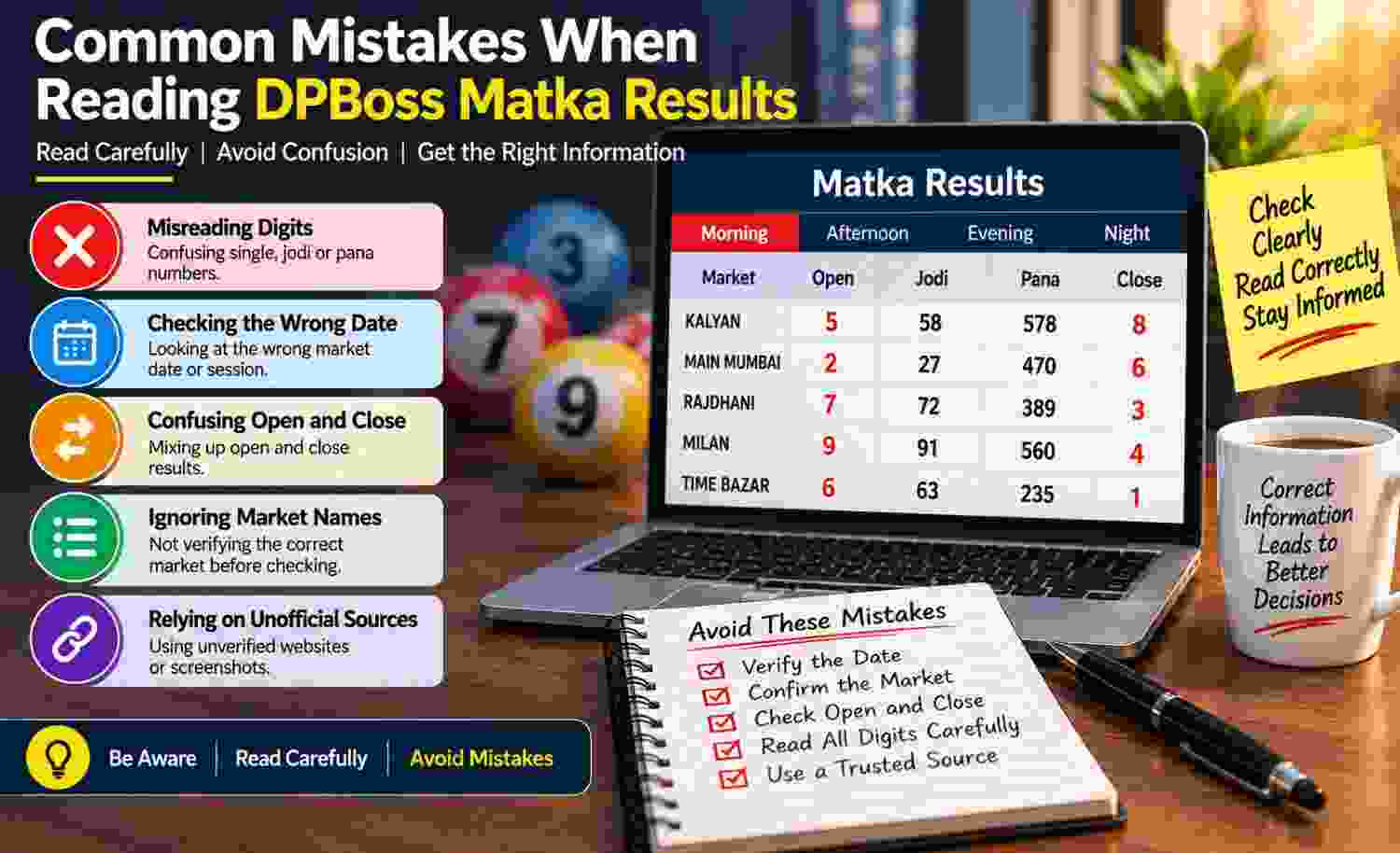
Matka result pages can contain several markets, dates, sessions, fields, archives, and status indicators at once. Small reading errors can therefore lead to incorrect interpretation even when the page itself displays information clearly. Common problems include selecting the wrong market, reading an adjacent date, confusing opening and closing fields, overlooking session labels, or treating an incomplete entry as final. Accurate reading depends on checking the page structure in a consistent order. By verifying labels, dates, chronology, status, and layout before accepting an entry, readers can reduce avoidable confusion and identify the correct published information reliably.
Why Result-Reading Mistakes Happen?
Result pages often compress large amounts of information into limited space. Multiple markets may appear in neighbouring rows, while several sessions can share one calendar date. Historical records may sit close to current entries, and mobile layouts can rearrange information that appeared side by side on a larger screen.
Confusion becomes more likely when readers focus only on a numerical field and ignore the surrounding context. Every displayed entry should be read as a group of connected details rather than as an isolated value.
The Context Around a Result Matters
Before interpreting any entry, confirm the surrounding information:
- market name;
- calendar date;
- session label;
- opening or closing field;
- result status;
- archive or current section;
- update timestamp, where shown.
These details establish what the entry represents and where it belongs within the page.
Mistake 1: Checking the Wrong Market Name
A common reading error starts with the wrong market. Dense pages may display several market names close together, making it easy to follow the wrong row, card, or column.
Why Market Labels Must Come First
The safest reading sequence begins with the written market name. After locating it, trace the date and session within the same visual block.
A page may mention DPBoss Satta in surrounding descriptive text, but that wording does not identify which market a particular entry belongs to. The actual market label attached to the result block remains the relevant reference.
Mistake 2: Reading the Wrong Date
Adjacent dates can look similar, especially in archives or compact mobile layouts. A reader may accidentally move one row up or down and associate the correct market with the wrong day.
How to Verify the Intended Date
Check the date itself, then compare neighbouring entries to confirm the sequence. If the format appears ambiguous, use the month or year heading and surrounding records as context.
Do not assume that the first visible entry always belongs to the intended day.
Mistake 3: Confusing the Latest Result With an Older Result
A latest-results section usually prioritises recent entries, while archives preserve older records. However, the visual difference between these areas may be subtle.
Confirm Recency Through the Date
Use the assigned result date as the primary reference. Labels such as latest or recent can help with navigation, but they do not replace date verification.
If the intended record is older, move to the historical section or locate the appropriate date within the current listing.
Mistake 4: Ignoring Session Labels
One calendar date can contain morning, daytime, evening, night, opening, closing, or other session categories. Ignoring these labels can cause two different entries to appear equivalent when they are not.
Match the Session Before Reading the Field
Check the session name after confirming the market and date. Then read only the result field attached to that session.
Mistake 5: Mixing Opening and Closing Fields
Opening and closing fields may appear next to each other, beneath one another, or inside separate labelled boxes. If the labels are overlooked, a reader can easily treat one field as the other.
Follow Labels, Not Screen Position
Do not assume the left field is always opening or the right field is always closing. Responsive layouts can change field positions.
Instead, read the written field label and confirm that it belongs to the intended market, date, and session before interpreting the displayed information.
Mistake 6: Treating an Incomplete Entry as Final
Blank, pending, partial, unavailable, or incomplete fields require cautious interpretation. A visible placeholder does not automatically represent a completed result.
What Incomplete States Can Indicate
Depending on the page design, an entry may appear as:
- blank;
- pending;
- incomplete;
- unavailable;
- partially populated;
- awaiting an update.
Without a clear completed status or populated field, treat the entry as incomplete rather than final.
Mistake 7: Reading the Wrong Chronological Direction
Some result lists place the newest dates first, while others begin with older records. Assuming the wrong direction can lead readers to select the wrong day or archive position.
Identify the Sequence Before Scrolling
Compare two or three neighbouring dates. If the dates become older as the page moves downward, the list uses descending order. If they become newer, it uses ascending order.
Mistake 8: Confusing Result Dates With Update Timestamps
A result date identifies the calendar day assigned to a market record. An update timestamp may show when the page or entry was changed.
Why the Difference Matters
An update time can appear close to a result and look like part of the record. However, it should not replace the result date unless the page explicitly labels it that way.
Mistake 9: Overlooking Historical or Archive Sections
Older results may move away from the main page after newer entries appear. Readers who search only the first screen can therefore assume that a record is missing.
Where Earlier Records May Appear
Historical information may be organised through:
- daily archives;
- weekly groups;
- monthly sections;
- year-based records;
- pagination;
- expandable history blocks.
After opening an archive, confirm the market and date again because the layout may differ from the current-results section.
Mistake 10: Assuming Every Market Uses the Same Schedule
Different markets can use different session structures, publication patterns, or display conventions. A completed entry in one market does not prove that another market should show information at the same moment.
Treat Each Market Independently
This principle also applies to opening and closing fields, session names, and archive organisation, which may not follow identical patterns across the page.
Mistake 11: Assuming a Blank Field Means Cancelled
An empty field alone does not establish why information is missing. It may reflect an incomplete update, an unavailable entry, a loading issue, or another page-specific condition.
Use Explicit Status Information
Look for nearby labels or page context before assigning meaning to the blank space.
If no explanation appears, the most accurate interpretation is simply that the field does not currently display completed information.
Mistake 12: Reading Adjacent Rows or Columns
Dense result layouts can cause eye-tracking errors. A reader may start in the correct row, move sideways, and accidentally read a value from the next market or date.
Trace the Entry From Label to Field
Start with the market name and follow the same row or card to the date, session, and result field. If the layout is crowded, pause at each label rather than scanning directly across several columns.
On mobile screens, verify stacked fields after scrolling because visual alignment may change.
Mistake 13: Ignoring Mobile Layout Changes
Responsive pages often reorganise wide tables into stacked cards, collapsed sections, or horizontally scrollable blocks. Important labels can move away from the fields they originally sat beside.
Mobile-Specific Reading Problems
Common mobile issues include:
- hidden columns;
- truncated labels;
- horizontal scrolling;
- collapsed accordions;
- stacked session fields;
- sticky headers covering information;
- archive controls below the visible area.
Expand or scroll through the relevant section, then recheck the market, date, and session before reading the field.
Mistake 14: Overlooking Active Page Filters
Date selectors, market filters, session filters, or archive controls can change which records appear. A filter left active from an earlier search may make the page seem incomplete or inconsistent.
Check the Current Filter State
Before interpreting a missing or unexpected entry, confirm whether the page is limited by:
- date;
- month;
- year;
- market;
- session;
- archive range.
Mistake 15: Comparing Unequal Entries Across Markets
Cross-market comparisons become misleading when the entries do not represent equivalent dates, sessions, or field types.
Compare Like With Like
Before comparing two published entries, verify:
- the same calendar date;
- equivalent session categories;
- matching opening or closing fields;
- comparable current or historical status.
If these elements differ, treat the entries as separate records rather than direct equivalents.
Mistake 16: Treating a Delayed Update as Permanently Missing
A field may remain blank or pending because the visible page has not yet been updated. Publication timing and page refresh behaviour can differ.
Check Status Before Drawing a Conclusion
Review the entry-specific status, update label, neighbouring records, and archive location. A normal page refresh may also reveal a newer view.
Mistake 17: Failing to Recheck Market and Date Together
Readers sometimes verify the market first, scroll a long distance, and then forget whether the date still belongs to the same section.
Use a Two-Part Verification
Before accepting any entry, recheck both pieces together: the correct market and the intended calendar date.
Then confirm the session, field type, status, and page section. This final check catches many errors caused by scrolling, filtering, or switching between current and historical views.
Common Signs That a Result May Be Misread
Consistent labels make repeated checks faster and easier to follow.
Look again when:
- the date does not match the intended day;
- the market heading differs from the intended market;
- only one field appears complete;
- the session label does not match;
- the page shows historical instead of current entries;
- a timestamp appears beside the record;
- the value sits in an adjacent row or column;
- a filter remains active;
- the mobile layout hides part of the field;
- the entry remains blank or pending.
A Practical Result-Reading Checklist
A consistent verification process can reduce errors across different page layouts.
Follow this sequence:
- Confirm the exact market name.
- Verify the calendar date.
- Identify the relevant session.
- Check whether the field represents opening, closing, or another labelled category.
- Confirm the chronological direction.
- Review whether the entry is complete, blank, pending, or unavailable.
- Separate the result date from any update timestamp.
- Determine whether the page shows current or historical records.
- Review active filters or archive selections.
- Confirm that the displayed value belongs to the correct row or column.
- Recheck the layout if information appears truncated.
- Compare only equivalent entries across different markets.
Conclusion
Accurate result reading depends on context rather than isolated fields. Market names, dates, sessions, opening and closing labels, chronological direction, status indicators, archives, timestamps, filters, and page layout all influence interpretation. Most errors occur when one of these details is overlooked or assumed. A consistent verification sequence helps readers identify the correct published entry, separate current records from historical ones, and recognise incomplete information without assigning unsupported meaning. Rechecking the market and date together before accepting any displayed field remains one of the simplest ways to reduce avoidable reading mistakes. Clear labels matter most when several records appear together.
FAQs
1. How can I avoid selecting the wrong market?
Start with the written market heading rather than the position of a result block. Then trace the same row, card, or section to the date and session. Mobile layouts can move elements, so confirm the market label again after scrolling, expanding sections, or changing filters.
2. How do I identify the correct result date?
Read the displayed calendar date and compare neighbouring entries to confirm the sequence. If the page uses a shortened or numeric format, check the surrounding month or year heading. Do not rely solely on the entry's position, because current and historical sections may use different ordering.
3. Why do session labels matter when reading results?
Session labels separate entries that share the same date but belong to different periods or categories. Morning, daytime, evening, night, opening, or closing labels may therefore identify distinct records. Confirm the session before reading the field so that information from neighbouring sessions is not accidentally combined.
4. How are opening and closing fields different?
Opening and closing fields are separate labelled parts of some result listings. Their screen positions may change across layouts, particularly on mobile devices. Read the field name rather than assuming that the first or second visible value always represents the same category across every page structure.
5. What does a blank result field mean?
A blank field does not have one universal meaning. It may indicate incomplete, pending, unavailable, or not-yet-displayed information, depending on the page. Look for nearby status labels and contextual clues. Without a clear completed status, treat the field as incomplete rather than as a confirmed result.
6. How can chronological order cause reading errors?
A reader may expect newest entries first while the page displays older records first, or vice versa. Compare several neighbouring dates to identify the direction before scrolling. Once the sequence is clear, follow it consistently so that adjacent days are not mistaken for the intended date.
7. How is a result date different from an update timestamp?
The result date identifies the calendar day assigned to the record, while an update timestamp indicates when the page or entry may have changed. Use the result date for identifying the intended record. Treat update information as supporting context rather than as a replacement for that date.
8. Why should historical sections be checked carefully?
Archive layouts may differ from current-result sections and can use different chronological directions, grouping methods, or pagination. After opening a historical area, confirm the market, date, and session again. This prevents an older neighbouring record from being mistaken for the specific entry you intended to locate.
9. How can mobile layouts affect result reading?
Mobile pages may stack columns, hide fields behind horizontal scrolling, collapse sections, or shorten labels. These changes can separate a field from its original heading. Expand and scroll through the relevant block, then confirm the market, date, session, and field label before interpreting the visible information.
10. How should results across different markets be compared?
Compare only entries that share equivalent calendar dates, session categories, and field types. Also confirm whether both records belong to similar current or historical sections. Matching screen positions alone are not enough because separate markets can use different layouts, schedules, or publication patterns across the same page.