
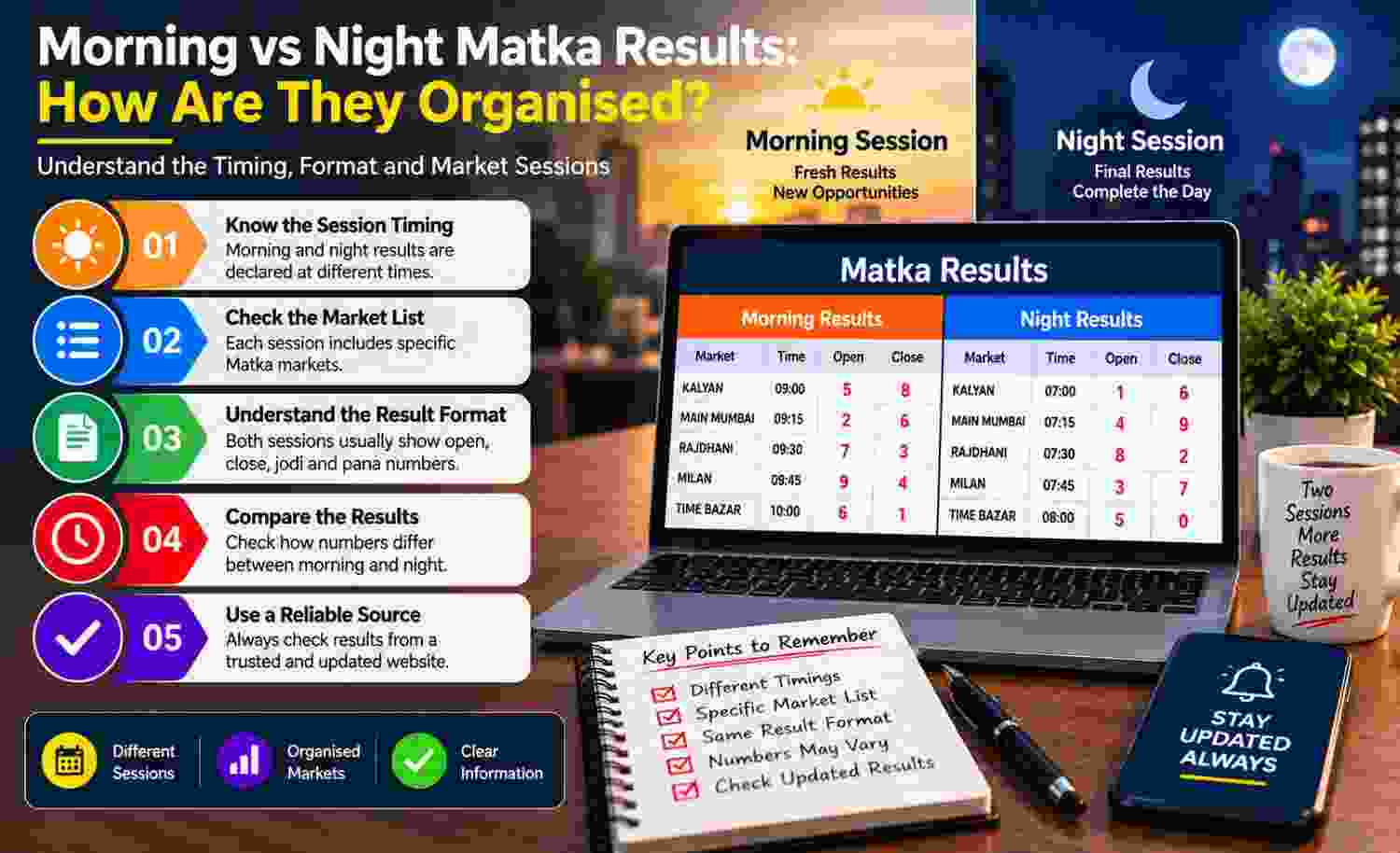
Morning and night Matka results usually appear as separate time-based entries so readers can identify the relevant session without mixing records from different periods. Result-oriented pages commonly use headings, dates, session labels, numerical fields, update markers, and archives to organise this information. However, layouts and timing conventions can vary between sources, so readers should rely on the labels shown on the specific page rather than assume a universal schedule. Clear organisation makes it easier to distinguish current entries from older records, verify the relevant date, and recognise whether a listed result belongs to a morning or night session.
What Morning and Night Result Categories Mean?
Morning and night categories function primarily as organisational labels. They separate result entries associated with different scheduled periods and allow a page to present multiple sessions without placing every record in one undifferentiated stream. A morning label generally identifies the earlier designated session, while a night label identifies the later one.
These labels do not establish one universal clock time. Different result sources may use different naming systems, schedules, or publication patterns. Consequently, a reader should treat the displayed session name and accompanying time as the relevant indicators.
Why Time Periods Are Separated
Time-based separation improves information architecture. When several result periods share the same date, a single date heading cannot identify which entry belongs to which session. Adding morning and night labels creates another layer of classification.
- distinguish earlier and later entries;
- locate the intended session quickly;
- compare records within the same date;
- avoid confusing an older entry with a later update;
- follow archives arranged by date and session.
Therefore, the category label works much like a filing marker. It tells readers where an entry belongs within the page structure rather than explaining anything about participation.
How Morning Results Are Usually Organised
Morning result sections generally place the session name close to the relevant date and result field. Some layouts use a dedicated morning heading, while others place a small session tag beside each entry. The central purpose remains the same: the page should visually associate the displayed information with the earlier scheduled period.
Readers should not need to scan unrelated entries to determine which date, time, or status belongs to a morning record.
Typical Morning Entry Structure
A morning entry may contain several informational elements, depending on the layout. Common fields include:
- the calendar date;
- a morning or equivalent session label;
- a scheduled or published time, when supplied;
- the numerical result field;
- an update or pending indicator;
- a link or route to older records, where available.
The exact numerical format can differ. For that reason, readers should interpret the structure according to the headings and field labels on the page rather than infer missing information.
Some pages place the newest morning entry first. Others use ascending date order, especially inside monthly archives. Accordingly, readers should check the ordering pattern before assuming that the first visible row represents the latest record.
How Night Results Are Usually Organised
Night sections follow similar organisational principles but identify the later designated session. A page may place night information beneath the morning section for the same date, in a separate block, or within a combined chronological listing. Clear labelling matters most when both sessions appear close together.
Typical Night Entry Structure
A night entry commonly combines a date, session identifier, result field, and status information. If the page displays times, the time should appear close enough to the session label to prevent readers from associating it with another entry.
Presentation may follow patterns such as:
- one night block for each date;
- a paired morning-and-night block;
- separate morning and night archives;
- a single chronological feed with session tags;
- grouped monthly records containing both periods.
How Dates and Timings Are Commonly Displayed
Dates provide the primary anchor for historical and current result organisation. A page may show a full date, an abbreviated date, or a day-and-month format. Archives may also group entries beneath a month or year heading to reduce repetition.
Timing information, when displayed, can indicate a scheduled session time, an update time, or another page-specific time reference. Therefore, readers should check the nearby label rather than assume every clock value means the same thing.
Reading Date Labels Correctly
A clear date structure should make three relationships obvious: which date applies to the entry, which session belongs to that date, and which result field belongs to that session.
Potential date arrangements include:
- one date heading followed by morning and night entries;
- repeated dates beside every session;
- monthly headings containing daily records;
- reverse chronological lists with the newest date first.
Date formats can also vary. For instance, numeric formats may place the day before the month, while other layouts spell out the month. Readers should use surrounding records to confirm the pattern when a short numeric date could be ambiguous.
Chronological Order and Daily Sequencing
Chronological organisation helps readers determine how entries relate across days and sessions. Pages commonly use either ascending order, which moves from older to newer records, or descending order, which places the newest entries first.
Neither method is inherently incorrect. What matters is consistency and clear date labelling. A sudden reversal in ordering can make readers misidentify an old record as a recent one.
How Sessions Fit Within a Date
When a page groups both sessions under one date, morning normally appears as the earlier category in the sequence and night as the later category. Nevertheless, layout choices can alter visual order. Responsive designs, separate panels, or archive templates may position sections differently.
Readers should therefore use this checking sequence:
- identify the date group;
- locate the session label;
- read the associated result field;
- confirm any time or status marker;
- move to the next date only after separating both sessions.
This method is particularly useful when several consecutive dates use nearly identical formatting. It reduces reliance on colour, spacing, or assumptions about screen position.
Latest Results and Historical Records
Result-oriented pages often separate recent information from archives. A latest-results area prioritises current or recently populated entries, while a historical section stores earlier dates for reference. The archive may use daily, monthly, or yearly grouping depending on the amount of information retained.
This separation prevents a long historical list from overwhelming the most recent entries. Additionally, it gives readers a clearer route when they want a specific older date rather than the newest record.
How Archives May Be Arranged
Historical records can follow several structures. A page might provide month headings, date indexes, expandable sections, pagination, or separate session archives. In each case, the archive should preserve enough context to identify both date and session.
A useful archive structure maintains:
- consistent date formatting;
- stable morning and night labels;
- predictable chronological direction;
- clear month or year boundaries;
- visible separation between adjacent records.
Historical entries should not appear current merely because they occupy a prominent position. Accordingly, readers should verify the date before treating any displayed record as the latest entry.
How Update Status Is Typically Indicated
A result page may need to show a session before its numerical field has been populated. Status indicators help explain that state. Common approaches include textual markers, empty placeholders, timestamps, or a visibly changed result field after publication.
Explicit text provides the clearest signal. By contrast, an empty box can have several meanings, including pending information, missing data, or a loading problem.
Signs That an Entry May Have Been Updated
Readers can look for several page-level signals:
- a populated result field where a placeholder previously appeared;
- an explicit updated or published label;
- a timestamp clearly identified as an update time;
- movement of the entry into a latest-results area;
- a status change from pending to a completed state.
However, a page refresh time does not necessarily equal a result publication time. Likewise, a general “last updated” notice may apply to the entire page rather than one session. Readers should connect timestamps only with the entry that the layout explicitly associates with them.
Identifying the Correct Date and Session
Correct identification requires more than spotting a numerical field. Readers should first establish the date, then the session, and only then read the associated result. This order prevents common errors when morning and night blocks use similar typography.
A page mentioning DPBoss Matka in surrounding informational text still requires the same date-and-session checks because names do not replace structural labels.
A Practical Reading Check
Before interpreting an entry, readers can make five simple checks:
- Confirm the date displayed for the record.
- Identify whether the session says morning, night, or another defined period.
- Check whether a time label belongs to the session or to the page update.
- Locate the result field within the same visual group.
- Verify whether the status indicates completed, pending, or another state.
These checks focus entirely on information architecture. They are especially useful when a page contains advertisements, navigation blocks, archive links, or other visual elements between result sections.
Why Layouts Can Differ Between Result Pages
No single layout governs every result-oriented page. Designers may choose cards, lists, grids, accordions, tabs, or separate archive pages. Screen size also affects presentation: a two-column desktop arrangement may become a single vertical sequence on a phone.
Consequently, readers should focus on semantic cues such as headings, dates, labels, and status text. Visual familiarity with one layout may not transfer reliably to another.
Why Consistent Formatting Improves Readability
Consistency reduces the mental effort required to scan repeated records. When every date uses the same order, labels, spacing, and status placement, readers can move through the page without repeatedly decoding its structure.
Moreover, consistent formatting supports mobile readability. Narrow screens often remove horizontal relationships, so explicit labels become more important when columns stack vertically.
Common Causes of Confusion
Result listings can become difficult to read when several similar entries appear together. Confusion often comes from presentation rather than from the result field itself. Weak spacing, unclear dates, inconsistent labels, and ambiguous timestamps can all disrupt interpretation.
Readers should slow down when the page structure changes between current and archived sections.
Page Elements Worth Checking Carefully
Common sources of confusion include:
- a date heading that applies to several entries;
- morning and night labels placed far from their values;
- timestamps without an explanation of what they represent;
- blank fields that lack a status label;
- archive records displayed near current records;
- mobile stacking that changes the desktop visual order;
- inconsistent abbreviations for session names;
- navigation elements inserted between related records.
Additionally, cached or partially refreshed pages can create uncertainty about whether displayed information is current. A visible status marker or entry-specific update label provides stronger evidence than assumptions based on page position.
Conclusion
Morning and night Matka result organisation relies on clear relationships among dates, session labels, result fields, timings, status markers, and archives. Although layouts vary, readers can interpret them more accurately by checking the date first, identifying the relevant session, confirming any status information, and recognising the page’s chronological pattern. Clear headings and consistent formatting reduce confusion, particularly when current and historical records appear close together, or mobile layouts rearrange sections. Rather than assuming a universal schedule or format, readers should follow the explicit organisational cues presented with each entry.
FAQs
1. What is the basic difference between morning and night result sections?
Morning and night sections separate entries associated with different scheduled periods. The distinction usually appears through session labels, positioning, dates, or timing information. Because schedules can vary, readers should rely on the page’s explicit labels rather than assume that every source uses identical hours or naming conventions.
2. Do morning and night results always have fixed timings?
No universal timing applies across every result source. A page may display scheduled times, publication times, or only session names. Readers should check the specific labels provided beside each entry. If no time appears, the morning or night identifier and date usually provide the main organisational context.
3. Why is the date sometimes shown only once for two sessions?
Some layouts group all sessions for one calendar date beneath a single date heading. This reduces repeated text and keeps related entries together. When reading such a layout, readers should confirm that both morning and night blocks visually sit within the same dated group before associating them with that date.
4. Are the newest results always displayed at the top?
Not necessarily. Many current-result sections favour newest-first ordering, but archives may use oldest-first sequences or month-based groups. Readers should compare several adjacent dates to identify the direction. A clear date label offers more reliable evidence of recency than the physical position of a record alone.
5. How are historical morning and night results normally stored?
Historical records may appear in daily lists, monthly groups, yearly archives, expandable sections, or separate session collections. Good archive organisation preserves both the date and session identity for every record. Readers should check the archive heading and chronological direction before locating a specific earlier morning or night entry.
6. How can I tell whether a result entry has been updated?
Look for an explicit status change, a populated field, or an entry-specific update timestamp. A general page timestamp may describe the whole page rather than one result. Likewise, an empty field alone does not prove that an update is pending unless the surrounding layout clearly indicates that status.
7. Why do numerical result formats look different across pages?
Result pages may use different separators, boxes, spacing, labels, or field groupings. These presentation choices can make similar information look different. Readers should use nearby headings and field labels to identify what each displayed element represents instead of assuming that punctuation or visual styling has a universal meaning.
8. How can I avoid mixing morning and night entries?
Check the date first, then locate the session label, and finally read the result field within that same visual group. If times appear, confirm what they describe. This sequence reduces confusion when entries use similar styling or when a mobile layout stacks previously side-by-side sections vertically.
9. What does a blank result field usually mean?
A blank field can indicate pending information, missing data, a loading issue, or an intentionally empty record. Its meaning depends on the page design. Readers should look for a nearby status label, placeholder text, or update marker rather than treating every blank field as evidence of the same condition.
10. Why might the mobile layout show sessions in a different position?
Responsive pages often rearrange columns into vertical blocks so content fits smaller screens. As a result, morning and night sections that appeared side by side on desktop may stack differently on mobile. Session names, dates, and labels therefore provide more dependable identification than screen position or visual proximity alone.